You walk most mornings. You have done for years. And yet the stairs feel harder than they used to, the shopping bags feel heavier, and getting out of the low sofa has started to involve a small strategy.
Both things can be true: your walks are helping, and your routine may still need something more. New or worsening difficulty also deserves attention rather than being written off as age.
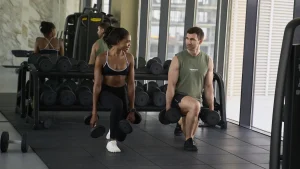
Walking is a practical way to stay active and it can contribute meaningfully to aerobic fitness. What a familiar, level route does not fully train is the strength to lift, push and rise, or balance challenged in a controlled way. Public health guidance for adults aged 65 and over pairs aerobic activity with strengthening, balance and flexibility work.
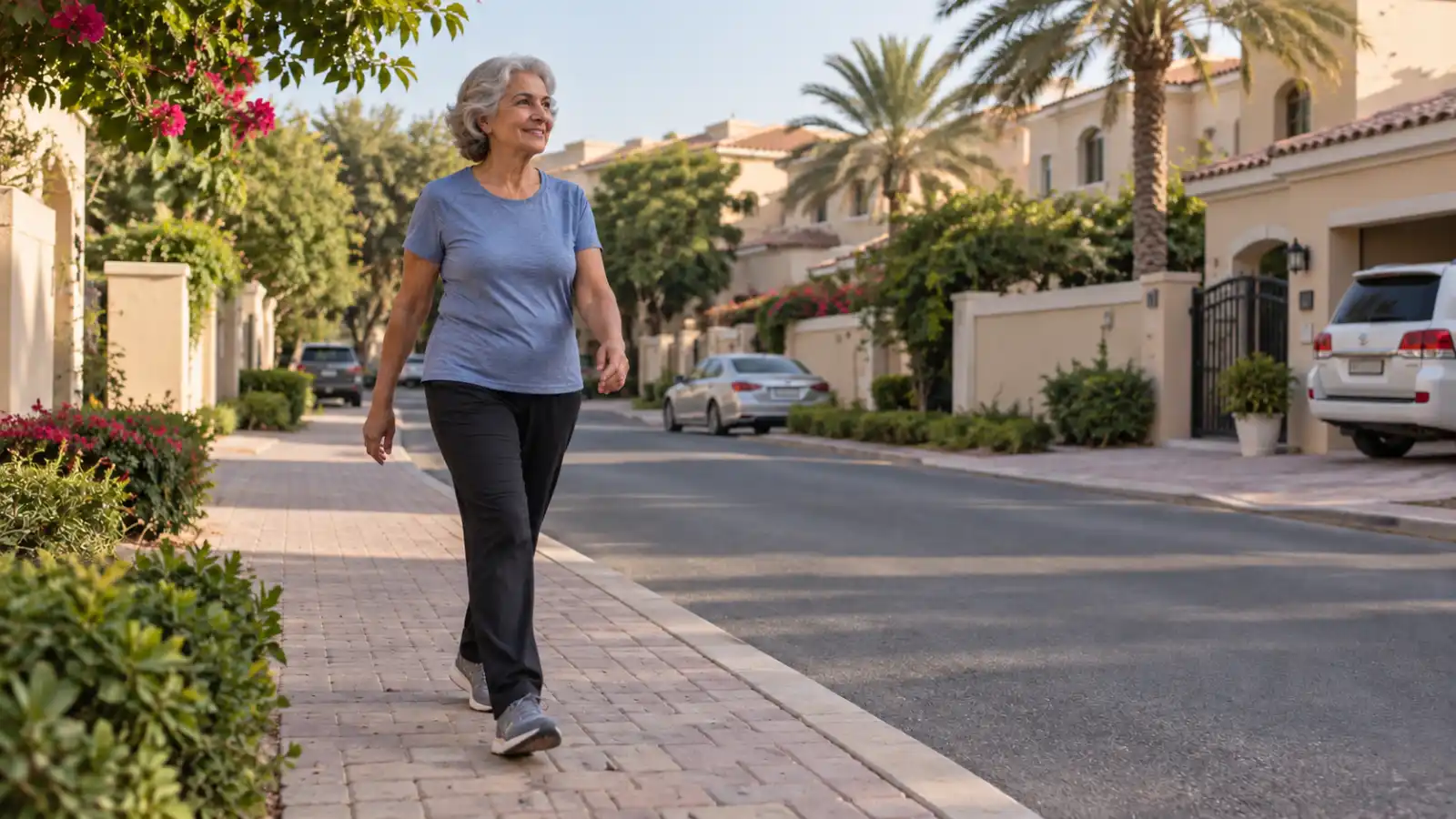
A brisk walk at a pace where you can talk but not sing counts towards the weekly aerobic target.
Guidance suggests strengthening, balance and flexibility work on at least two days a week, built up gradually.
A 30-second screening test used in falls prevention. Read the safety notes further down before trying it.
This article is general information, not medical advice. New or worsening difficulty with everyday movement deserves attention from a healthcare professional rather than being written off as age.
What Walking Already Does Well
Walking is a practical way to stay active. You can adjust the route, pace and duration, and it fits naturally into many people’s days. A brisk walk can contribute to aerobic fitness; a gentler walk still gets you moving.
A 2025 review in The Lancet Public Health brought together 57 studies from 35 cohorts. Higher daily step counts were associated with better outcomes across several aspects of health. For some outcomes, the curves showed diminishing returns around 5,000 to 7,000 steps a day.
That gives you a reason to value a manageable walk rather than treating anything below 10,000 steps as failure. But these were observational findings, not proof of cause and effect, and they do not establish one step target for every person over 60.
The NHS physical activity guidelines for older adults combine aerobic activity with strengthening, balance and flexibility. For adults aged 65 and over, they recommend working towards 150 minutes of moderate activity a week and activities that improve strength, balance and flexibility on at least two days. Start with what you can manage and build up.
A useful guide to moderate intensity is being able to talk but not sing. A relaxed stroll may not reach that intensity, but it still has a place in your day.
What a Familiar Walk Does Not Fully Train
Walking uses your leg muscles and requires balance. It can be a meaningful challenge if you are starting from a low activity level. The limitation is that a familiar, level route may become too easy to keep improving strength, and it gives your upper body little resistance to work against.
Standing from a low seat, lifting a suitcase and pushing a heavy door make different demands. Extra steps alone do not systematically train all of them. Likewise, steady forward walking does not replace exercises designed to challenge balance in a controlled setting.
The practical question is therefore: where does your week ask you to push, pull, lift and control your body beyond your usual walk?
Why Your Dubai Routine Deserves a Closer Look
Think about the hours around your morning walk. Do you drive for most errands? Are your groceries delivered? Do lifts and household help mean you do less physical work than you used to?
Those conveniences may suit your life perfectly. They can also reduce the movement you do without planning it. The useful response is to notice the gaps and deliberately include the activities you want to maintain.
None of these are problems in themselves. They are simply worth noticing, because the movement you do without planning it can quietly shrink while your walk stays the same.
-
Stairs
Do you take stairs, or the lift?
If the lift is quick and reliable, climbing a flight may have quietly left your week.
-
Carrying
Do you carry your own shopping?
Delivery is convenient. It also removes one of the few loaded carries in a typical week.
-
Errands
Do you drive for most errands?
Worth noticing how much walking sits between your front door and where you are going.
-
Household
How much lifting and reaching do you still do?
Household help is a reasonable choice, and it changes how often you bend, lift and reach.
-
Floor Level
When did you last get up from the floor?
If everything you need sits at chair height, this rarely comes up until it matters.
-
Weather
What happens when it is too hot to walk?
If the walk is your only activity, hot or humid stretches remove all of it at once.
If several of these gave you pause, that is useful information rather than a verdict. It points to which activities you may want to include deliberately rather than leaving them to chance.
This does not mean walking works less well in Dubai. It means your whole routine matters, including what happens when hot or humid weather keeps you indoors.
Try the 30-Second Chair Stand With the Right Setup
The chair stand is one way to look at lower-body strength and endurance. It is part of the CDC STEADI assessment resources. It is a screening tool, not a diagnosis or a pass-or-fail verdict on independence.
Before trying it: if you have fallen recently, feel unsteady or dizzy, have had recent surgery, or have pain or medical restrictions affecting movement, ask a healthcare professional about an appropriate assessment first. Do not attempt a timed test alone if you might lose your balance.
-
1
Set Up the Chair
Use a stable chair without arms, with a seat approximately 43 cm high, placed against a wall so it cannot slide backwards. Keep the space in front of you clear.
-
2
Have Someone With You
Do not attempt a timed test alone if there is any chance you could lose your balance. Someone nearby can also handle the timer for you.
-
3
Take the Starting Position
Sit with your back straight, feet flat on the floor and shoulder width apart, and your arms crossed over your chest with hands on opposite shoulders.
-
4
Count Full Stands in 30 Seconds
Rise fully and sit back down, repeating with control for 30 seconds. Keep your arms crossed. Count each full stand. If you are more than halfway up when time ends, count the final repetition. If you need your arms to stand, stop; the standardised CDC test records a score of zero.
Ask a healthcare professional first if any of these applyYou have fallen recently, feel unsteady or dizzy, have had recent surgery, or have pain or medical restrictions affecting movement. Stop straight away if you feel unwell, and seek urgent help for chest pain, fainting or severe breathlessness.
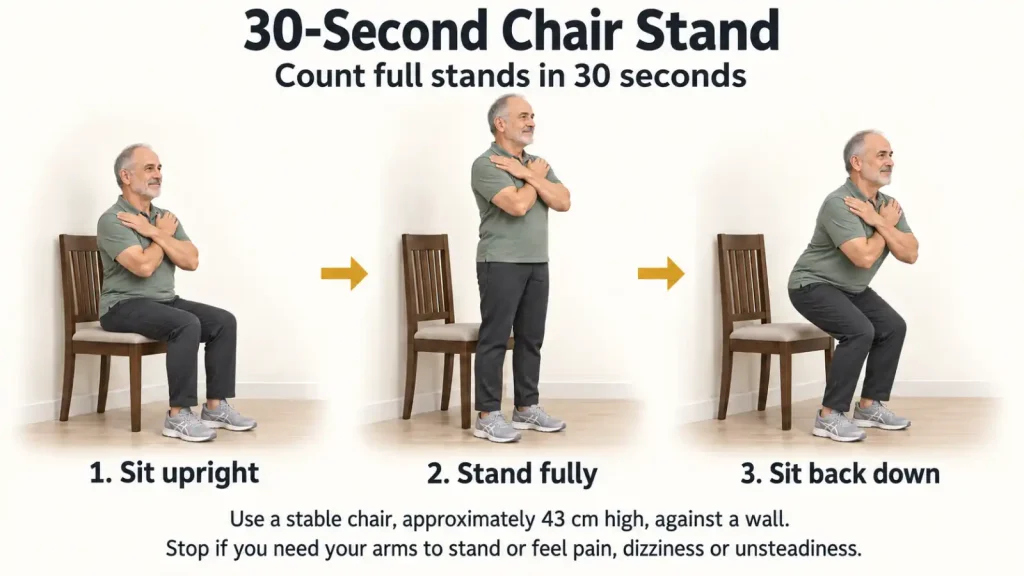
Count the full stands you completed in 30 seconds and compare with your age group. A score below the figure shown is described as below average for lower-body strength. These are population reference ranges, not a verdict about you.
| Age | Men | Women |
|---|---|---|
| 60 to 64 | Under 14 | Under 12 |
| 65 to 69 | Under 12 | Under 11 |
| 70 to 74 | Under 12 | Under 10 |
| 75 to 79 | Under 11 | Under 10 |
| 80 to 84 | Under 10 | Under 9 |
| 85 to 89 | Under 8 | Under 8 |
Reference ranges established by Rikli and Jones and used in the CDC STEADI falls prevention resources. View the CDC test sheet
A low score can have several explanations. Discuss it with a healthcare professional, especially if it accompanies falls or a recent change in how you move. An above-threshold score does not exclude balance problems or other causes of falls.
If you repeat the assessment later, use the same chair and setup and record the date and result. Avoid interpreting one small change as proof that a programme has worked or failed.
Outside the test, notice whether everyday tasks are becoming harder. Use the stair handrail whenever it helps. These observations are useful to discuss with a professional; they are not additional standardised tests.
What Strength and Balance Training Add
A network meta-analysis of 151 randomised trials in adults aged 60 and over found that even lower resistance-training volumes improved physical function in healthy older adults. More training may help maximise some strength outcomes. Evidence was more limited for people with existing physical impairments.
That supports a manageable starting routine with gradual progression. It does not mean every short workout produces the same result, or that the easiest version should remain your programme indefinitely.
For falls, a Cochrane review found that exercise programmes reduced the rate of falls by about 23% on average. Balance and functional exercises had clear supporting evidence. There was insufficient evidence to determine the effect of programmes consisting mainly of walking.
For practical starting points, see the NHS guides to strength exercises and balance exercises. Our guide to seven core movement patterns also explains the movements behind a balanced training plan.
A beginner’s strength session might include supported sit-to-stands, wall push-ups and a suitable pulling exercise. Balance practice can begin beside a sturdy support. Choose the variation and amount that allow steady, controlled movement, then increase the challenge gradually. The timed chair test and your everyday training are different: using support during an exercise can be an appropriate adaptation.
Build It Around Dubai’s Weather and Your Week
Use outdoor walks when conditions suit you and have an indoor option ready for days when they do not. The calendar alone cannot tell you whether a particular morning is comfortable or appropriate for you.
- Community paths, parks and promenades
- Earlier mornings or after sunset if daytime heat is an issue
- Shaded routes with somewhere to sit along the way
- Water with you, and a route you can shorten
Judge the day, not the month. Comfort and safety depend on how a particular morning feels to you, not on the calendar.
- An air-conditioned mall before it gets busy
- A suitable indoor walking area with a clear, level surface
- Treadmill in your building gym, if you have access
- Strength and balance work at home
Have the indoor option ready in advance. Deciding on the day is what usually turns a hot week into a missed one.
For strength training, convenience matters. Our comparison of training at home, in a building gym or in a commercial gym can help you choose a setting you will actually use. Check your building’s access rules if you want a coach to attend.
One possible weekly structure is strength training on Monday and Thursday, with walking on the days that suit you. Add short, supported balance practice regularly, including on those strength days. Adjust the total to your ability and recovery rather than treating the schedule as a test to pass.
Attach the new habit to a familiar cue, such as finishing breakfast. Keep equipment easy to reach, but stored away from walkways. An uncluttered space matters more than having an impressive collection of equipment.
Can Short Exercise Snacks Help?
A systematic review published in June 2026 examined home-based exercise snacks in adults aged 60 and over: bouts lasting one to ten minutes, performed at least twice daily. Across eight small studies with 317 participants, improvements in strength, balance and functional mobility were generally reported, with high adherence and few reported adverse events.
This is encouraging if a long session feels like a barrier. However, the studies were small and the evidence remains limited. We cannot assume that any five-minute routine will produce the same benefits as a well-designed longer programme, or that long-term results are established.
A short period of appropriate strength or balance practice can be a starting point. The exercises, progression and total work across the week still matter.
If You Are Taking a GLP-1 Medication
If your weight is changing during treatment, discuss how to support your strength as well as your weight-loss goals. The 2025 joint clinical advisory on GLP-1 therapy highlights nutrition and resistance exercise as part of that conversation.
When Individual Support Makes Sense
Speak to a healthcare professional about falls, persistent dizziness, unsteadiness, significant pain or new difficulty with everyday movement. Stop exercising and seek urgent medical help for chest pain, fainting or severe or unusual breathlessness.
A coach can help you select suitable exercises, learn technique and progress the resistance as you improve. Balance work should be challenging enough to be useful while remaining appropriately supported.
Fit with Rozzie’s private senior coaching in Dubai offers individual training at home or in a suitable building gym, subject to access. Your walking habit can be part of the plan, alongside strength and balance work and any relevant medical guidance. Coaching does not replace physiotherapy or medical care.
For a broader introduction, read our guide to exercise for seniors in Dubai. If you have never worked with a coach, our personal trainer for beginners guide explains what support can involve.
If You Are Reading This for a Parent
Start with what they want to keep doing: walking with friends, carrying their own shopping or getting up comfortably to play with grandchildren. Ask whether any of those tasks have become harder.
Offer to help arrange an assessment or find suitable support if they would like it. Avoid turning a chair stand score into a competition or asking them to attempt the test alone when safety is uncertain.
Frequently Asked Questions
Is walking 30 minutes a day enough after 60?
Thirty minutes of brisk walking can make a useful contribution to aerobic fitness. It does not cover all your strength and balance needs. Keep the walks and include muscle-strengthening sessions at least twice a week, alongside regular balance practice suited to your ability.
Do I really need 10,000 steps?
No single step count is right for everyone. A 2025 review found substantial health associations below 10,000 daily steps. The evidence was observational and did not establish a universal target for people over 60. Build from your current capacity.
What if my chair stand score is below average?
Take it as a reason to discuss your strength and fall risk with a healthcare professional, particularly if you have fallen, feel unsteady or notice a recent decline. The score does not identify the cause, and a higher score does not rule out other risks.
Can I do strength training on the same day as my walk?
Yes. Choose an order that lets you perform both comfortably and with good control. If a long walk leaves your legs tired, shorten it or separate the sessions. Allow recovery between demanding strength sessions.
Do I need a gym to start?
No. A stable chair, a wall and suitable resistance equipment can support a home routine. Choose exercises you can control and increase the challenge gradually. Get help if you are unsure about technique, balance or medical restrictions.
Scientific Sources
The research and public health guidance below supports the step count, strength, balance, screening and medication points discussed in this article. None of it replaces advice from a healthcare professional who knows your situation.
-
2025 · Systematic Review and Meta-analysis
Daily Steps and Health Outcomes in Adults
The Lancet Public Health, 10(8):e668-e681. 57 studies from 35 cohorts. Observational associations, not proof of cause and effect.
View on PubMed -
2025 · Network Meta-analysis
Resistance Training Volume in Older Adults
Sports Medicine, 55(1):167-192. 151 randomised trials in adults aged 60 and over. Evidence more limited for people with existing impairments.
View on PubMed -
2019 · Cochrane Review
Exercise for Preventing Falls in Older People Living in the Community
Cochrane Database of Systematic Reviews, CD012424. Balance and functional exercise had clear supporting evidence; walking-based programmes did not.
View on Cochrane -
2026 · Systematic Review
Home-Based Exercise Snacking in Older Adults
European Geriatric Medicine. Eight small studies with 317 participants. Encouraging but limited evidence; long-term results not established.
View on PubMed -
2025 · Joint Clinical Advisory
Nutritional Priorities to Support GLP-1 Therapy for Obesity
Joint advisory from ACLM, ASN, OMA and TOS. Covers muscle and bone loss and the role of nutrition and resistance exercise in supportive care.
Read the Advisory -
Public Health Guidance
NHS Activity Guidelines and CDC STEADI
NHS physical activity guidelines for older adults, and the CDC STEADI chair stand test with reference ranges from Rikli and Jones.
View NHS Guidelines