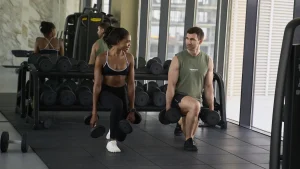
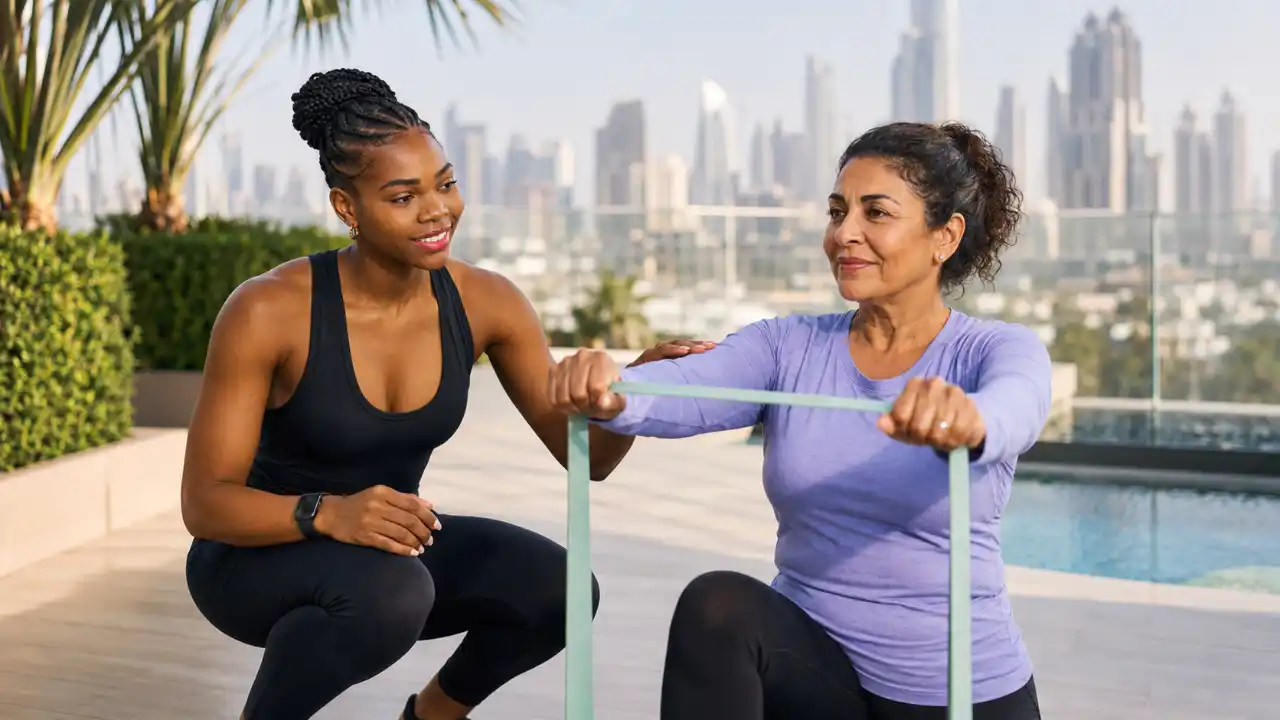
Aging does not mean you have to accept stiffness, weakness or feeling unsure in your own body.
But staying active as you get older comes with some specific challenges in Dubai. For much of the year, the heat makes outdoor movement uncomfortable or impractical. Life here can also mean long periods in cars, offices and air-conditioned buildings, with fewer opportunities for natural daily movement.
Add a previous injury, joint discomfort, reduced confidence or fear of falling, and it can become very easy to move less without noticing it.
The body adapts to what you do regularly. If strength, balance and mobility are no longer challenged, they can gradually decline.
The opposite is also true.
With an exercise approach adapted to your current ability, health and lifestyle, you can maintain and improve strength, mobility, balance and confidence well into your 60s, 70s and beyond.
Quick Answer
The best exercise for seniors in Dubai combines strength training, mobility work, balance exercises and cardiovascular activity.
For adults aged 65 and older, the CDC recommends at least 150 minutes of moderate-intensity aerobic activity per week, muscle-strengthening activities on at least 2 days and regular activities that improve balance.
In Dubai, this does not mean spending hours in a commercial gym. Effective exercise can take place at home, in your building gym, in a swimming pool or in another comfortable indoor environment.
The key is to start at an appropriate level, progress gradually and choose exercises that fit your current ability and everyday goals.
Why Exercise Matters More as You Get Older
Many people think aging is mainly about doing less.
Less walking. Less lifting. Less bending. Less training.
But healthy aging is not about avoiding movement. It is about choosing the right kind of movement.
The World Health Organization recommends that older adults combine aerobic activity with muscle-strengthening exercise and activities that emphasize functional balance.
Dubai has also increased its focus on physical activity. In April 2026, the Dubai Health Authority published its Physical Activity Guideline.
Daily life itself requires physical capacity.
You need leg strength to get out of a chair.
You need grip and upper-body strength to carry groceries.
You need mobility to get comfortably in and out of a car.
You need balance and coordination to walk confidently.
And you need stamina to travel, spend time with family and remain independent.
Active aging is not about training like a 25-year-old. It is about training so your body continues to support the life you want to live.
Why Strength Training Becomes More Important After 60
Many people associate exercise for seniors primarily with walking and stretching.
Both can be useful, but they are not a complete exercise program.
Strength training deserves a central role.
Muscle strength supports everyday tasks such as:
- getting up from a chair
- climbing stairs
- carrying shopping bags
- lifting luggage
- maintaining posture
- getting toward the floor and back up
- playing with grandchildren
- recovering your balance when you stumble
A 2025 systematic review and network meta-analysis of 151 randomized trials found that resistance training can improve physical function, lean body mass, muscle size and strength in older adults.
Strength training does not automatically mean lifting heavy weights.
Resistance can come from:
- bodyweight
- resistance bands
- dumbbells
- resistance machines
- cable systems
- functional movements
Someone who has not exercised for several years may initially find repeated chair sit-to-stands challenging enough.
Someone who is already active may need additional resistance to continue progressing.
The exercise should fit the person, not the person’s age alone.
The Dubai Factor: Heat, Sitting and Indoor Living
Dubai can make exercise consistency more difficult when your routine depends on being outdoors.
During periods of extreme summer heat, Dubai Health Authority doctors have advised residents to avoid outdoor sports and physical activities between 9:00 am and 6:00 pm and to use indoor alternatives instead.
For an older adult, that may mean moving outdoor walks to early morning or evening and using indoor exercise for the rest of the day.
Practical Dubai options include:
- strength training at home or in your building gym
- short indoor mobility routines
- walking in air-conditioned indoor spaces
- swimming
- stationary cycling
- low-impact cardio
- balance work at home
- guided training when you are unsure where to begin
For older adults living in communities such as Emirates Hills, Dubai Hills Estate or Nad Al Sheba, home and building-gym training can also remove unnecessary travel and make consistency easier.
A similar challenge can occur when parents or in-laws visit family in Dubai for several weeks or months. A simple temporary routine can help them stay active even when they are away from their normal gym and daily habits.
A good exercise plan should work with Dubai life rather than against it.
The 4 Types of Exercise Seniors Should Prioritize
A well-rounded program does not need dozens of different exercises.
It should cover four main areas.
1. Strength
Strength training helps maintain muscle and supports everyday movements.
Useful exercises may include sit-to-stands, squats, rows, wall push-ups, step-ups, resistance-band exercises and machine-based exercises.
The CDC recommends muscle-strengthening activity on at least 2 days per week for adults aged 65 and older.
2. Mobility
Mobility means being able to move your joints through useful ranges of motion with control.
It supports activities such as bending, reaching, turning, getting in and out of a car and moving toward the floor.
Mobility work should be controlled rather than forced.
3. Balance
Balance is a trainable physical skill and becomes increasingly important with age.
Supported single-leg standing, heel-to-toe walking, controlled stepping and changes of direction can all be useful.
Always perform balance exercises somewhere you can safely use a wall, chair or another stable surface for support.
4. Cardiovascular Exercise
Walking, swimming, stationary cycling, elliptical training and low-impact circuits can all support cardiovascular fitness and stamina.
Walking is excellent, but walking alone does not replace strength and balance training.
A complete program combines the different components.
A Simple FITT Framework for Beginners
If you have not exercised regularly for a while, the FITT principle can make starting much simpler.
FITT stands for Frequency, Intensity, Time and Type.
Frequency: Start with a schedule you can realistically repeat. Two strength sessions per week combined with regular walking or other light activity can be a practical starting point.
Intensity: Begin at a light to moderate effort. During moderate cardiovascular activity, you should generally be breathing harder but still able to speak.
Time: You do not need to begin with long sessions. A 15 to 20-minute workout can be enough when you are getting started. Duration can increase gradually as your fitness improves.
Type: Combine different forms of activity rather than doing only one. Strength, balance, mobility and cardiovascular exercise all have different jobs.
The goal is not to progress everything at once.
Increase your training gradually as movements become more comfortable and your capacity improves.
5 Safe Exercises for Seniors to Start With
You do not need a complicated workout to begin.
Before starting, spend a few minutes warming up with gentle movements such as marching in place, shoulder rolls or ankle circles.
These five exercises require little or no equipment.
This is not an individualized medical exercise plan. If you have significant pain, balance problems, recent surgery or a medical condition that affects exercise, seek appropriate professional guidance first.
1. Chair Sit-to-Stand
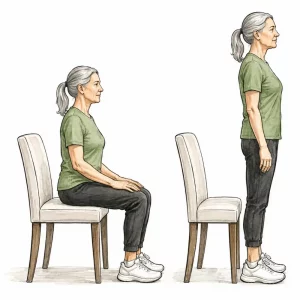
Sit toward the front of a stable chair with your feet comfortably underneath you.
Stand up with control and slowly return to the chair.
Try: 8 to 10 repetitions
2. Wall Push-Up
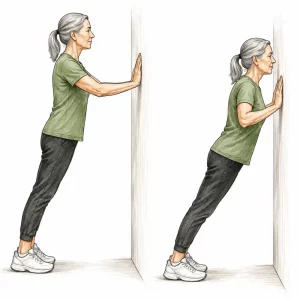
Place your hands against a wall around chest height.
Bend your elbows and bring your body toward the wall before pushing yourself away.
Try: 8 to 12 repetitions
3. Supported Heel Raises
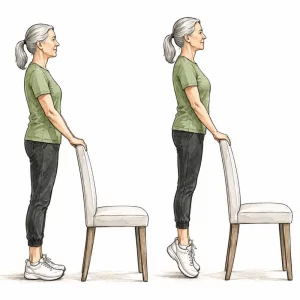
Stand behind a stable chair or beside a wall.
Rise slowly onto your toes and lower yourself again.
Try: 10 to 15 repetitions
4. Supported Balance Hold
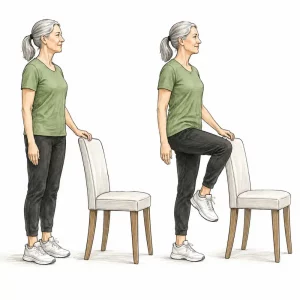
Stand close to a stable surface and slowly lift one foot slightly from the floor.
Try: 10 to 20 seconds per side
Use as much support as you need.
5. Controlled Hip Mobility
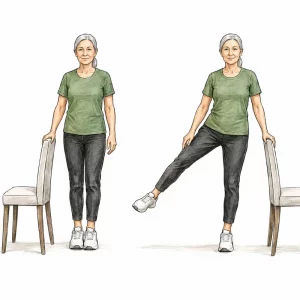
Stand beside a chair or wall and move one leg slowly through a comfortable range of motion.
Try: 30 to 45 seconds per side
Do not force the movement.
Start small. Move slowly. Focus on control.
You do not need to finish every workout exhausted for it to be effective.
How Often Should Seniors Exercise?
For many older adults, a realistic week might include:
- 2 or 3 strength sessions
- regular walking or another cardiovascular activity
- short mobility sessions
- regular balance practice
The CDC recommends at least 150 minutes of moderate-intensity aerobic activity per week for adults aged 65 and older, together with muscle-strengthening activity on at least 2 days and activities that improve balance.
That is a target, not necessarily your starting point.
If you currently do very little exercise, shorter sessions are completely reasonable.
Start with what you can repeat consistently and build from there.
When Should You Stop Exercising?
Knowing when to stop is part of training safely.
Stop exercising if you experience:
- chest pain, pressure or tightness
- dizziness, lightheadedness or feeling faint
- unusual or severe shortness of breath
- a new fast, pounding or irregular heartbeat
- nausea or feeling suddenly unwell
- severe or unexpected pain
These symptoms are different from the normal effort of exercise.
If symptoms are severe, persistent or concerning, seek appropriate medical attention rather than continuing the workout.
Older adults with cardiovascular disease, osteoporosis, diabetes, recent surgery, significant balance problems or other conditions that may affect exercise should discuss appropriate activity with their healthcare professional.
Senior Emiratis: A Note on the UAE Legal Context
The UAE also has a specific legal framework for older Emirati citizens.
Federal Law No. 9 of 2019 on the Rights of Senior Emiratis defines Senior Emiratis as UAE nationals aged 60 or older.
The law protects rights including independence and privacy, access to an enabling environment, social care and medical care.
The wider National Policy for Senior Emiratis also includes community involvement and active life among its seven main pillars.
This is important context when discussing healthy and active aging in the UAE, but the distinction matters:
The legal definition and specific rights under Federal Law No. 9 of 2019 apply to Emirati citizens, not automatically to expatriate residents living in Dubai.
For more information: https://u.ae/en/information-and-services/social-affairs/senior-emiratis
When Personal Coaching Makes Sense
Not every older adult needs a personal trainer.
If you already understand exercise technique, progression and how to adapt training to your body, you may be perfectly capable of exercising independently.
Coaching becomes more useful if you:
- are returning after years without structured exercise
- do not know which exercises are appropriate
- feel unsteady or worried about falling
- have limited mobility
- want to build strength safely
- need help staying consistent
- have previous injuries requiring modifications
- want someone to monitor technique and progression
Age alone does not determine the program.
Two people can both be 65 and need completely different training.
One may want enough strength and mobility for travel. Another may want to climb stairs more confidently. Someone else may be returning after surgery or trying to regain confidence following a fall.
Exercise selection, resistance, range of motion, balance support, training frequency and progression should reflect those differences.
Your training should support what you want your body to do in everyday life.
This is the approach behind our Senior Personal Training in Dubai.
Sessions focus on practical strength, mobility, balance and confidence and can take place at your home, villa or building gym depending on your location and trainer availability.
If you want broader one-on-one fitness support, you can also explore our Personal Training in Dubai.
Not sure which approach is right for you? Read our guide to choosing the right personal trainer in Dubai.
Start With What You Can Do Today
You do not need a perfect training program before you begin.
Choose one realistic action.
That might be:
- 5 minutes of mobility
- 10 chair sit-to-stands
- a 10-minute indoor walk
- one short strength session
- a few minutes of supported balance practice
Then repeat it.
Once that becomes normal, gradually add more.
You are not training to prove how fit you are today. You are training to preserve what you want your body to be able to do tomorrow.
Ready to Move with More Strength and Confidence?
If you want to stay strong, mobile and independent as you age, you do not need extreme workouts or unsafe exercises. You need a safe, structured and personal approach that fits your body and your lifestyle.
FAQ
What is the best exercise for seniors over 60?
There is no single best exercise. A well-rounded program should combine strength training, cardiovascular activity, mobility and balance work.
How many times a week should seniors exercise?
The CDC recommends at least 150 minutes of moderate-intensity aerobic activity per week for adults aged 65 and older, muscle-strengthening activity on at least 2 days and regular balance activity. Beginners can start below these targets and progress gradually.
Is strength training safe for seniors?
For many older adults, yes. Strength training can be safe and beneficial when exercise selection, resistance and progression are appropriate for the individual.
Can I start strength training after 60 or 70?
Yes. Age alone is not a reason to avoid resistance training. Your starting point should reflect your current health, strength, mobility and training experience.
Can seniors build muscle after 60?
Yes. Research shows that older adults can improve strength and lean body mass through structured resistance training.
Is outdoor exercise safe for seniors during Dubai summer?
Extreme heat increases the risks associated with outdoor exercise. During very hot summer conditions, DHA doctors have advised avoiding outdoor sports and physical activity between 9:00 am and 6:00 pm. Indoor exercise is often the more practical option.
Is walking enough exercise for seniors?
Walking is excellent cardiovascular activity, but it does not fully replace strength and balance training.
Do seniors need a gym to exercise?
No. Many effective exercises can be performed at home using bodyweight, a chair, resistance bands or light weights.
Can you train a parent who is temporarily visiting Dubai?
Potentially, yes. Training can be adapted around their current ability, health considerations, available space and length of stay.
Do you offer personal training for seniors in Dubai?
Yes. Fit with Rozzie offers Active Aging & Mobility Coaching in Dubai focused on strength, mobility, balance and everyday confidence.
Scientific Sources & Clinical References
World Health Organization. WHO Guidelines on Physical Activity and Sedentary Behaviour.
https://www.who.int/publications/i/item/9789240014886
Dubai Health Authority. Physical Activity Guideline. External Circular #0426, April 2026.
https://dha.gov.ae/en/
Exhaustion and Heat Stroke During Summer in Dubai.
https://www.dha.gov.ae/en/media/news/152
UAE Ministry of Health and Prevention. Healthy Diet and Physical Activity.
https://mohap.gov.ae/en/w/healthy-diet-and-physical-activity
Centers for Disease Control and Prevention. Older Adults: Adding Activity Recommendations.
https://www.cdc.gov/physical-activity-basics/adding-older-adults/index.html
Radaelli R, et al. Effects of Resistance Training Volume on Physical Function, Lean Body Mass and Lower-Body Muscle Hypertrophy and Strength in Older Adults. Sports Medicine. 2025.
https://pubmed.ncbi.nlm.nih.gov/39405023/
Sadaqa M, et al. Effectiveness of Exercise Interventions on Fall Prevention in Ambulatory Community-Dwelling Older Adults. Frontiers in Public Health. 2023.
https://pubmed.ncbi.nlm.nih.gov/37601180/
American Heart Association. Develop a Physical Activity Plan for You.
https://www.heart.org/en/health-topics/cardiac-rehab/getting-physically-active/develop-a-physical-activity-plan-for-you
UAE Government. Senior Emiratis and Federal Law No. 9 of 2019.
https://u.ae/en/information-and-services/social-affairs/senior-emiratis