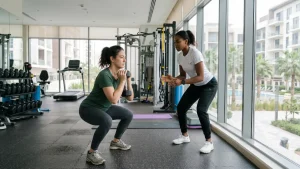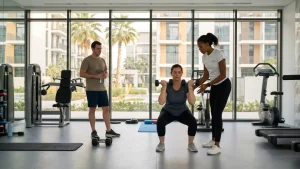

You’re halfway through your warm-up and the weight you lifted comfortably last week already feels heavy. Your period is due in a day or two. Should you go lighter, or is this just one of those workouts?
“Cycle syncing” gives you an answer in advance. It typically tells you to lift harder before ovulation and ease off afterwards. The research gives you more room to decide on the day.
Quick Answer
You can lift weights during your period if you feel comfortable. As of November 2026, the studies reviewed here offer little support for planning harder and easier strength workouts by menstrual cycle phase alone. Keep a regular strength programme and adjust the weight, sets or exercise when cramps, fatigue or poor sleep change what you can comfortably do that day.
What the Research Says About Cycle Syncing and Lifting
Can your cycle affect how strong you feel today?
It can feel different from one session to the next. A large 2020 review found that exercise performance was slightly lower on average in the first days of the cycle, around the start of bleeding. The average difference was very small and results varied across studies. A 2024 review found some phase differences in laboratory tests of strength. For tests that involved moving a load, the average difference was small and based on relatively few studies.
In a 2026 study, 28 women with strength-training experience completed about eight weeks of supervised training. Their bench press and trap-bar deadlift speeds differed only slightly across cycle phases. Pain showed small associations with lifting speed that went in opposite directions for the two exercises.
Does cycle syncing help you gain more strength or muscle?
A 2026 randomised trial followed 24 young women with regular cycles who had not done structured lower-body strength training for at least six months before enrolment. Over about 12 weeks, researchers compared steady leg training with plans that concentrated more sets before or after ovulation. They verified cycle phases with hormone measurements and matched the total number of sets. The phase-based plans produced no clear advantage in leg strength or muscle growth. The trial was small and focused on lower-body training, so it leaves room for research in other groups.
Where Your Period Fits in the Menstrual Cycle
Day one is the first day of your period and the start of the follicular phase. That phase lasts until ovulation, when an ovary releases an egg. After ovulation comes the luteal phase, when progesterone rises. This phase ends when your next period begins. Ovulation timing varies, including between cycles of similar length. A calendar app can log when you bleed and estimate when ovulation might happen. Confirming ovulation takes additional information.
How to Adjust Your Workout When Your Period Affects It
Here’s a practical coaching approach you can try. Start with your usual warm-up and one light set of your first lift. Compare it with how the same lift normally feels at that weight. If it feels heavier or more uncomfortable than usual, change one thing first, such as the weight or the number of sets.
- The warm-up feels normal
- Follow your planned sets and weights. Progress when you’re ready, even if you’re on your period.
- Everything feels heavier than usual
- Drop the weight one step or do one fewer working set. Keep a few comfortable reps in reserve.
- One exercise feels uncomfortable
- Try a setup that feels better, such as a supported split squat in place of walking lunges. Skip the exercise if the discomfort persists.
- You’d rather rest
- End the session or take a rest day. If movement feels good, try an easy walk or gentle cycling.
Goblet Squat Example
If cramps are mild but your warm-up feels unusually hard, start with a lighter weight.
- Planned workout
- 12 kg · 3 sets of 8
- First working set
- 10 kg
If 10 kg feels comfortable, keep it for the remaining sets. If you’re still tired, you can stop after two sets. At your next session, use your warm-up to see whether 12 kg feels right again.
New to lifting? Learn the seven movement patterns behind a balanced strength routine.
How to Spot a Pattern Across Your Cycles
If you’re curious whether your workouts feel different at certain points, jot down a few details after each session for two or three cycles. Record when bleeding starts, any symptoms, how you slept and how your first working set felt.
First day of my period. Mild cramps, six hours of sleep. Squats felt harder than usual.
If the first day of bleeding repeatedly makes lower-body training uncomfortable, you could make that day flexible and move the harder session when it suits your week. If your notes show no clear pattern, your usual programme is a sensible default. You can keep these details private and simply tell your coach how you feel on the day.
When to Speak to a Doctor About Period Symptoms
Speak to a doctor if period pain or heavy bleeding regularly disrupts training, work or other everyday activities, or if you’ve missed three periods in a row. Seek urgent medical advice if your pelvic or period pain is severe or worse than usual and pain relief hasn’t helped.
Build a Strength Routine That Fits Your Week
If you’d like help choosing exercises, progressing your weights and adjusting sessions when needed, explore one-to-one coaching with a female personal trainer in Dubai.
Frequently Asked Questions
Can I lift heavy weights on my period?
Yes, if you feel well and the load is appropriate for your experience. If your warm-up feels normal, you can continue with your planned session. If cramps or fatigue make your usual load feel harder, adjust it or rest.
Should I plan my hardest workouts around ovulation?
There’s little evidence that scheduling your hardest lifts around ovulation improves long-term results. If you’re ready for a heavier session, pick a day when you’ve recovered well and have the time to train.
Can I use a cycle-syncing plan if I take the pill?
If you use the combined pill, it usually stops ovulation. Bleeding during a pill break or while taking inactive pills is typically a withdrawal bleed, so the phases of an ovulatory cycle are a poor guide to planning your workouts. You can still pay attention to recurring symptoms and use your warm-up to choose a suitable load.
References
- McNulty et al. (2020). The Effects of Menstrual Cycle Phase on Exercise Performance in Eumenorrheic Women: A Systematic Review and Meta-Analysis. Sports Medicine.
- D’Souza et al. (2026). Menstrual Cycle Phase Does Not Influence Training-Induced Muscle Hypertrophy or Strength: A Randomized Controlled Trial. Medicine & Science in Sports & Exercise.
- Niering et al. (2024). The Influence of Menstrual Cycle Phases on Maximal Strength Performance in Healthy Female Adults: A Systematic Review with Meta-Analysis. Sports.
- Munteanu et al. (2026). The Effect of Menstrual Cycle Phase, Symptoms, Motivation, and Readiness to Perform on Resistance Training Performance. Sports Medicine.
- NHS. Periods and fertility in the menstrual cycle.
- Verhagen et al. (2025). UEFA consensus statement on menstrual cycle tracking in women’s football. BMJ Open Sport & Exercise Medicine.
- NHS. Period pain.
- NHS. Heavy periods.
- NHS. Missed or late periods.
- NHS. What is the combined pill?
- NHS. How to take the combined pill.