School drop-offs in air-conditioned cars, hours sitting in classrooms, homework at the desk and evenings in front of a screen. For many children in Dubai, sitting has become a normal part of everyday life.
A weekly football practice or swimming lesson might feel like enough. But how much physical activity do growing children really need?
On 4 November 2026, the World Health Organization (WHO) published new global estimates showing that millions of teenagers are not getting sufficient physical activity. The findings deserve parents’ attention: regular movement supports healthy bones and muscles, physical fitness, mental well-being and the development of movement skills.
The question is not whether your child is good at sports. It is whether movement has become too small a part of their childhood.
Quick Answer
How Much Exercise Do Children Need?
For ages 5-17. Active play, swimming, cycling, running and sport count. Children do not need an hour-long gym workout every day.
The WHO Warning: Millions of Teenagers Are Not Moving Enough
The WHO’s report, A Generation Missing Out: Global Trends in Adolescent Physical Activity, 2010-2025, draws on 389 population-based surveys involving more than 3.2 million adolescents aged 11-17 across 140 countries and territories.
The Global Picture | Adolescents Aged 11-17
2025 estimates from self-reported survey data. Not reaching 60 minutes does not mean no movement. Source: Strain et al., The Lancet Global Health (2026) .
The estimates showed virtually no global improvement between 2010 and 2025. Girls were less active than boys across nearly every country and WHO region.
An important distinction: a day without 60 minutes of moderate-to-vigorous activity is not necessarily a day without movement. A teenager may still have walked, played or exercised for shorter periods. The study used self-reported survey information and statistical modelling to estimate the number of days reaching this specific threshold.
The issue goes beyond individual motivation. Children depend on schools, families, safe places to play, transport and affordable opportunities to be active. Helping them move more means making movement a practical part of daily life.
Source: WHO news release, 4 November 2026
The Hidden Impact: Why Too Little Movement Matters for Growing Bodies
Childhood and adolescence are important periods for physical development. Bones grow, muscles become stronger, coordination develops and the cardiovascular system responds to regular activity.
Bone and muscle health. Running, jumping, climbing and age-appropriate resistance exercises place useful demands on growing bones and muscles. A 2024 systematic review found that exercise interventions improved certain measures of bone mineral content and density in adolescents.
Cardiovascular and metabolic health. Regular activity supports heart and lung fitness, metabolic health and healthier body composition. A child can appear slim while still having low cardiovascular fitness. Appearance alone is not a reliable indicator of physical health.
Mental well-being. A systematic umbrella review published in a 2026 journal issue found that structured exercise interventions reduced symptoms of depression and anxiety in children and adolescents. Exercise can support well-being, although it does not replace professional mental healthcare when needed.
Movement skills and confidence. Running, jumping, balancing, throwing and climbing help children practise skills that make physical activities easier and more enjoyable. Children with fewer chances to practise may find some activities more challenging.
The concern is not that every inactive child will develop a health problem. It is that too little movement can mean missing valuable opportunities for healthy development.
Why Physical Activity Matters for Both Boys and Girls
Boys and girls benefit from the same core ingredients: aerobic activity, muscle strengthening, bone-loading exercise and enjoyable play. Puberty, individual development and barriers to participation can influence their experiences, but no activity belongs exclusively to one sex.
Percentage of adolescents aged 11-17 reporting zero days reaching the 60-minute threshold in the previous week.
Bars use a 0-30% scale. This measures the 60-minute daily threshold, not complete inactivity. WHO, November 2026 .
For Boys: Bone Development, Strength and Fitness
Adolescence is an important period for skeletal and muscular development. A meta-analysis by Li and colleagues found that exercise improved whole-body bone mineral density in both girls and boys, with larger pooled effects among boys. These findings do not mean boys benefit from exercise while girls do not; both benefit.
Activities such as football, basketball, running, jumping and supervised resistance training can support strength and bone health. The American Academy of Pediatrics describes properly supervised, developmentally appropriate resistance training as a useful part of youth physical activity.
Boys also need aerobic fitness and a wide range of movement skills, rather than focusing only on competition or muscle size.
For parents: Encourage a mix of endurance, strength, coordination and play, including activities your son genuinely enjoys.
For Girls: Bone Health, Participation and Confidence
Childhood and adolescence are important years for building bone mass. Weight-bearing activities, including running, jumping, dance and resistance exercises, support skeletal development, which also matters for health later in life.
A long-term study of young women linked higher physical activity during youth with lower body fat percentages in adulthood, even after taking adult activity into account. This was an association, not proof that childhood exercise determines later body composition.
Puberty can also bring practical and social barriers to participation. A 2025 scoping review identified menstrual symptoms, stigma and access to menstrual products as possible barriers for some girls. Supportive environments and suitable activities can help make movement more accessible.
For parents: Encourage girls to become strong, capable and confident. Exercise should be associated with health and enjoyment, not pressure to achieve a particular body shape.
For both boys and girls, the goal is a positive, lasting relationship with movement.
Why Children in Dubai Face Their Own Movement Challenges
The WHO findings are global, but many Dubai families recognise the practical challenges behind a sedentary school week:
- School journeys often happen by car or bus rather than on foot or by bicycle.
- Homework, gaming and recreational screen time can extend sitting into the evening.
- High temperatures make outdoor activity unsuitable during parts of the year and day.
- Organised sports can mean extra travel and coordination around already busy schedules.
There is also local evidence that deserves attention. The Dubai Health Authority’s Physical Activity Guidelines (issued in March 2026) cite the 2019 Dubai Adolescent Risk Behaviour Survey.
Dubai also offers solutions: indoor pools, residential building gyms, suitable home-based activities and organised sports facilities. During cooler weather, parks and outdoor spaces can provide excellent opportunities to play.
For busy families, exercise at home or in a building gym can eliminate an additional journey across Dubai. The aim is to make movement part of normal routines, rather than something that happens only at an occasional sports lesson.
Is Your Child Moving Enough? Six Questions Every Parent Should Ask
You do not need advanced fitness testing to begin reflecting on your child’s usual week. These six questions are a practical starting point, not a medical assessment or validated fitness test.
Tick the questions you have considered. These selections stay on this page only and are not recorded.
Reflection tool only, not a medical assessment or a score. Not every child will prefer the same activities.
If several answers concern you, start with one realistic opportunity to increase movement. For some families that means more outdoor play during cooler weather; for others, it means finding a suitable indoor activity or supportive coaching.
Seven Practical Ways to Get Kids Moving More in Dubai
1. Build movement into the day. Encourage active play after school, short walks or movement before dinner. Smaller activity periods add up across a week.
2. Use indoor facilities during hotter months. Air-conditioned sports spaces, suitable building gyms and indoor pools allow children to stay active when outdoor conditions are unsafe or uncomfortable.
3. Make use of Dubai’s cooler-season spaces. A family walk at Kite Beach, age-appropriate cycling at Al Qudra or games at a neighbourhood park can make activity enjoyable. Consider the child’s abilities, supervision and weather.
4. Strengthen through play. Climbing, squatting, balancing, jumping and simple resistance exercises build movement skills. For a deeper explanation, see our article Is Strength Training Safe for Kids? What Parents Should Know.
5. Interrupt long sitting periods. Movement breaks during homework and screen time reduce uninterrupted sitting. They complement, rather than replace, more energetic physical activity.
6. Move together as a family. Swimming, walking, games or a parent-child training session make exercise shared time and allow parents to model positive habits.
7. Explore alternatives to team sports. Not every child enjoys competitive football or large classes. Swimming, dance, martial arts, cycling and individual coaching can provide equally valuable opportunities to move.
When Can Personal Training Help Your Child?
Many children can build healthy activity habits through active play, school PE and recreational sport. Some, however, benefit from individual support, especially when they feel uncomfortable in groups, need help with coordination or struggle to establish a routine.
At Fit with Rozzie, our Kids & Family Fitness Coaching in Dubai offers two approaches:
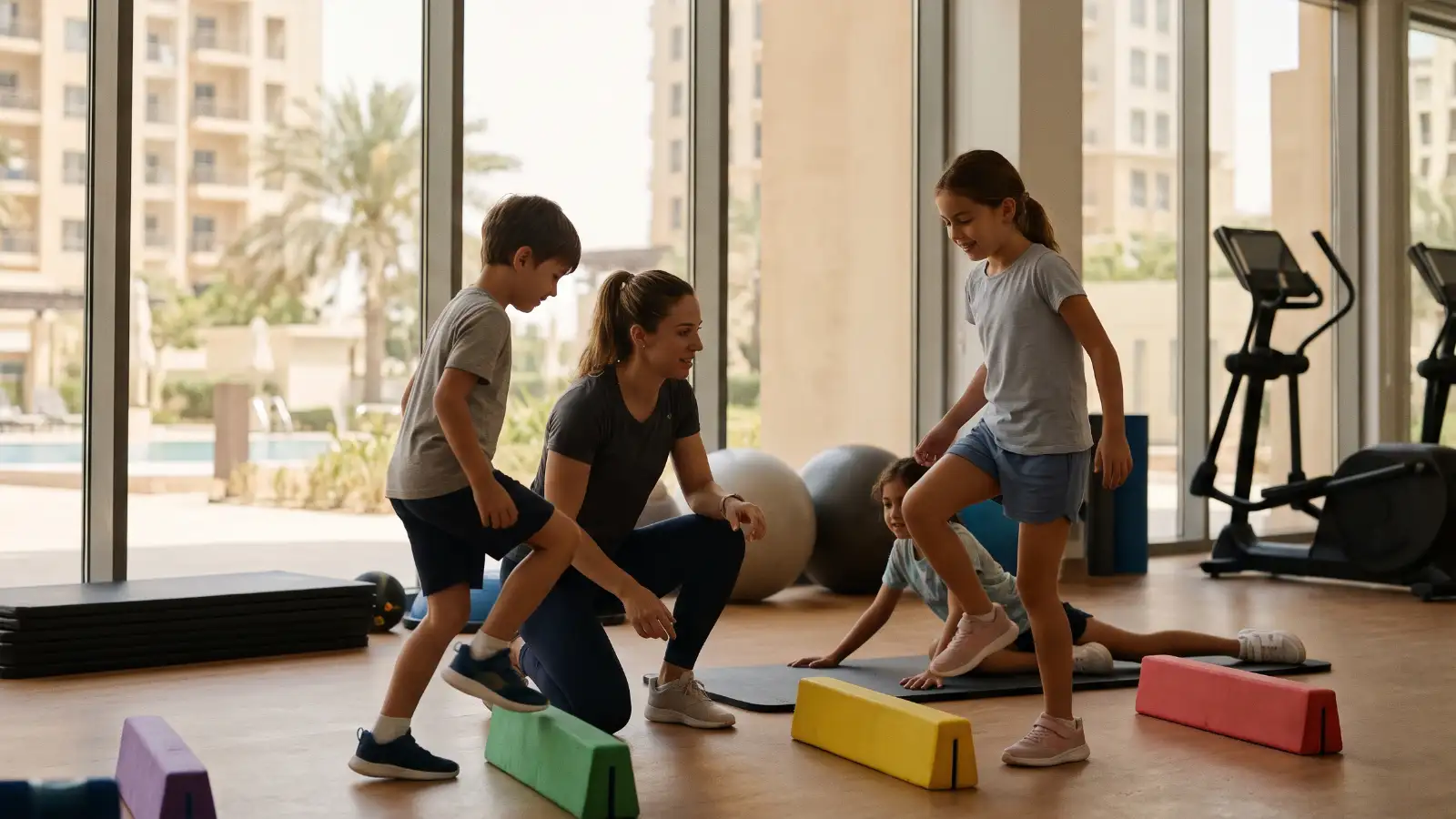
Active Kids: Private, age-appropriate coaching focused on strength, balance, coordination, general fitness and movement confidence.
Stronger Together: Parent-child sessions that make activity a shared family experience, with both participants coached at an appropriate level.
Sessions are generally available for children aged 6 and above and last 60 minutes, with activities and breaks adapted to the child’s abilities and readiness. Depending on location, access and coach availability, sessions can take place at home, in a villa, garden or building gym. The trainer brings the equipment needed for the session.
The priority is safe technique, encouragement and enjoyment, not turning every child into an athlete.
Frequently Asked Questions
How much exercise does a child need each day?
For ages 5-17, the WHO recommends an average of at least 60 minutes of moderate-to-vigorous activity per day across the week, with vigorous, muscle- and bone-strengthening activities on at least three days.
Is strength training safe for children?
Yes, when it is age-appropriate, supervised and progressively introduced. Exercise choice, technique and the child’s readiness matter more than the amount of weight lifted. Read our full strength-training guide for parents.
Is one football or swimming lesson a week enough?
A weekly sports lesson is a good start, but it usually will not provide all the recommended activity on its own. Children also need regular chances to move during the rest of the week.
What if my child dislikes organised sports?
Movement does not have to be competitive. Dance, active games, swimming, cycling, climbing and individual coaching are all options worth exploring.
At what age can children begin personal training?
There is no single minimum age for all supervised movement activities; readiness and the type of exercise matter. Fit with Rozzie generally offers structured Kids & Family Fitness Coaching from age 6.
A Healthier Future Starts With More Movement Today
The WHO’s latest figures are a reminder that physical inactivity among young people remains a persistent public health challenge. Yet improving the situation does not have to begin with an intensive training programme.
Children need frequent opportunities to play, run, jump, build strength, practise new skills and enjoy moving. Parents, schools and communities can all help make those opportunities easier to access.
Because a healthy childhood is not only about what children learn in the classroom. It is also about giving their growing bodies the movement they need.
Learn more about Coach Rozzie.
Scientific References
- Strain T, et al. (2026). National, regional, and global trends in adolescent physical activity from 2010 to 2025. The Lancet Global Health.
- World Health Organization (2026). One in four adolescents worldwide reported no active days in the previous week.
- World Health Organization (2020). WHO Guidelines on Physical Activity and Sedentary Behaviour.
- Dubai Health Authority (2026). Physical Activity Guidelines (p. 12).
- Zhang W, et al. (2024). Effects of exercise on bone mass and bone metabolism in adolescents: a systematic review and meta-analysis.
- Li Y, et al. (2026, online 2025). Effects of physical exercise on whole-body bone mineral density in adolescents: a systematic review and meta-analysis.
- Singh B, et al. (2026, online 2025). Effectiveness of physical activity in improving depression and anxiety in children and adolescents: systematic umbrella review and meta-meta-analysis.
- Stricker PR, Faigenbaum AD, McCambridge TM (2020). Resistance training for children and adolescents. Pediatrics.
- Hodge MG, et al. (2015). Youth and young adult physical activity and body composition of young adult women.
- Harvey J, et al. (2025). Adolescents, menstruation, and physical activity: insights from a global scoping review.
Medical disclaimer: This article provides general health and fitness information and does not replace medical advice. Exercise should be adapted to a child’s development, abilities and circumstances. Children with significant pain, injuries or medical conditions may need individual advice from a qualified healthcare professional before beginning a new exercise programme.