Pregnancy changes your body every week.
Your energy, breathing, balance, joints, core, and recovery can all feel different. That does not mean you have to stop moving.
It means your training needs to become smarter.
Many women hear two opposite messages during pregnancy. One side says you should avoid almost everything. The other side shows intense social media workouts that look exhausting even before pregnancy.
Neither extreme is helpful.
For most women with uncomplicated pregnancies, exercise is considered safe and beneficial when it is adapted properly and approved by a doctor or midwife. The goal is not to push harder. The goal is to move with more awareness, protect your body, and build strength for pregnancy, birth, and motherhood.
Quick Answer: Can You Train Safely During Pregnancy?
Yes. In most uncomplicated pregnancies, training is safe and beneficial when it is adapted to your body, trimester, symptoms, and medical guidance.
A safe prenatal workout plan usually includes moderate-intensity cardio, controlled strength training, pelvic floor and deep core awareness, mobility work, breathing mechanics, and enough recovery.
You should avoid high-risk activities, overheating, contact sports, heavy breath-holding, exercises that cause pain or abdominal doming, and anything that feels uncomfortable or unsafe.
Most important: always get medical clearance from your doctor or midwife before starting or continuing an exercise programme during pregnancy.
Why Prenatal Exercise Matters
Pregnancy is not a reason to become inactive. It is a reason to train with better structure.
The right kind of prenatal training can support:
- Strength: You build the muscles that help support your changing posture, growing belly, and daily movement.
- Energy: Moderate movement can help you feel more active and less physically stuck, especially when fatigue is present.
- Back and pelvic comfort: Glute, leg, back, and mobility work can reduce some of the mechanical stress that often builds during pregnancy.
- Mood and confidence: Movement can support mental wellbeing and help you feel more connected to your body.
- Preparation for motherhood: Strength training can prepare you for lifting, carrying, feeding positions, and the physical demands of early motherhood.
Clinical guidance from ACOG states that physical activity during pregnancy has minimal risks for most women and can benefit both physical and psychological health when appropriate modifications are made. ACOG and CSEP also recommend aiming for at least 150 minutes of moderate-intensity physical activity per week during pregnancy when there are no contraindications.
This does not mean every pregnant woman should follow the same plan. Pregnancy training should always be adapted to the individual.
The Biggest Misconception About Pregnancy Training
The biggest misconception is that pregnancy fitness is either unsafe or only for women who were already very fit before pregnancy.
The better way to think about it:
Pregnancy training is not about performance. It is about preparation.
You are not training to prove anything. You are training to support your body through a major physical transition.
A safe prenatal training plan should help you:
- move with confidence
- manage pressure through your core and pelvic floor
- strengthen the muscles that support posture and stability
- avoid unnecessary strain
- adjust exercises as your body changes
- leave each session feeling better, not depleted
Rozzie’s Coaching Perspective
With pregnant and postpartum clients, I often see the same pattern.
Many women are not sure what they are allowed to do. They are afraid of doing something wrong, but they also do not want to feel weak, inactive, or disconnected from their body.
That is exactly why prenatal training needs structure.
A good plan should not scare you. It should guide you.
It should help you understand which movements are safe, which ones need modifications, how to breathe, how to manage pressure, and when to slow down.
For pregnant clients in Dubai, I also consider lifestyle factors like heat, long workdays, home schedules, gym access, building gyms, family routines, and how tired the body feels from daily life before training even starts.
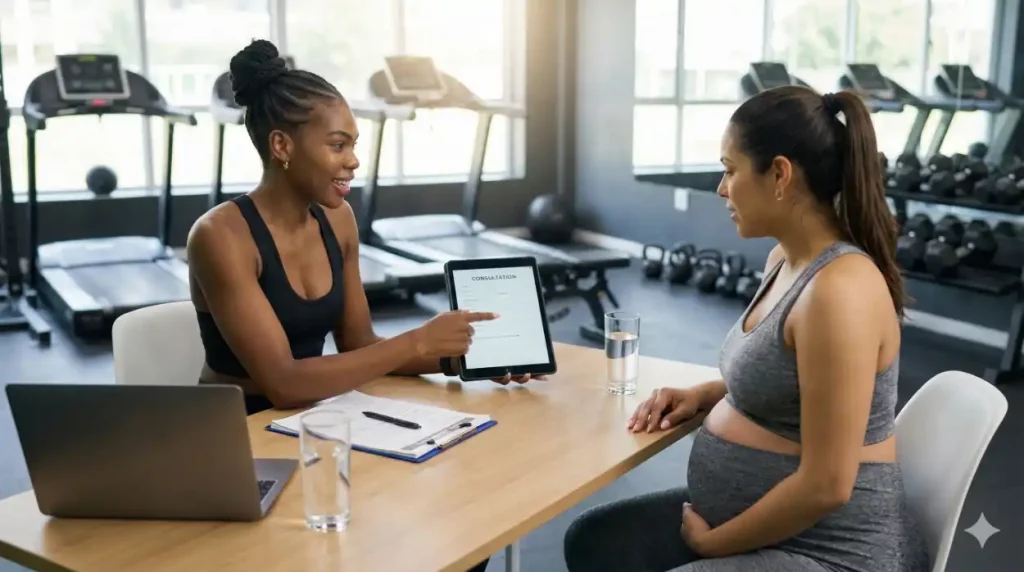
This is exactly why a structured Prenatal Coaching in Dubai can be so helpful: it gives you a plan that adapts to your body, your trimester, and your real schedule.
I hold specialist qualifications in pre- and postnatal fitness and work with pregnant and postpartum clients across Dubai. The guidance in this article aligns with current ACOG, RCOG, CSEP, and NHS recommendations on physical activity during pregnancy. [About Rozzie]
Message me on WhatsApp to book a free prenatal consultation and build a plan that helps you train with more confidence and control.
What Safe Pregnancy Training Actually Looks Like
A complete prenatal fitness plan usually includes five key pillars.
1. Low-Impact Cardio
Low-impact cardio helps support circulation, stamina, mood, and general fitness during pregnancy.
Good options include walking, swimming, stationary cycling, low-impact aerobic movement, and light incline walking if comfortable.
Use the talk test as a simple guide. You should be able to hold a conversation while exercising. If you cannot speak comfortably, the intensity is likely too high.
The old “keep your heart rate under 140 BPM” rule is outdated for many women. Pregnancy changes resting heart rate, blood volume, and how the body responds to effort. A better guide is perceived effort. Aim for a moderate intensity, around 6 to 7 out of 10, unless your healthcare provider gives you different guidance.
2. Strength Training
Strength training can be very valuable during pregnancy when performed with good technique, controlled breathing, and appropriate modifications.
The goal is not maximal strength. The goal is support, stability, and function.
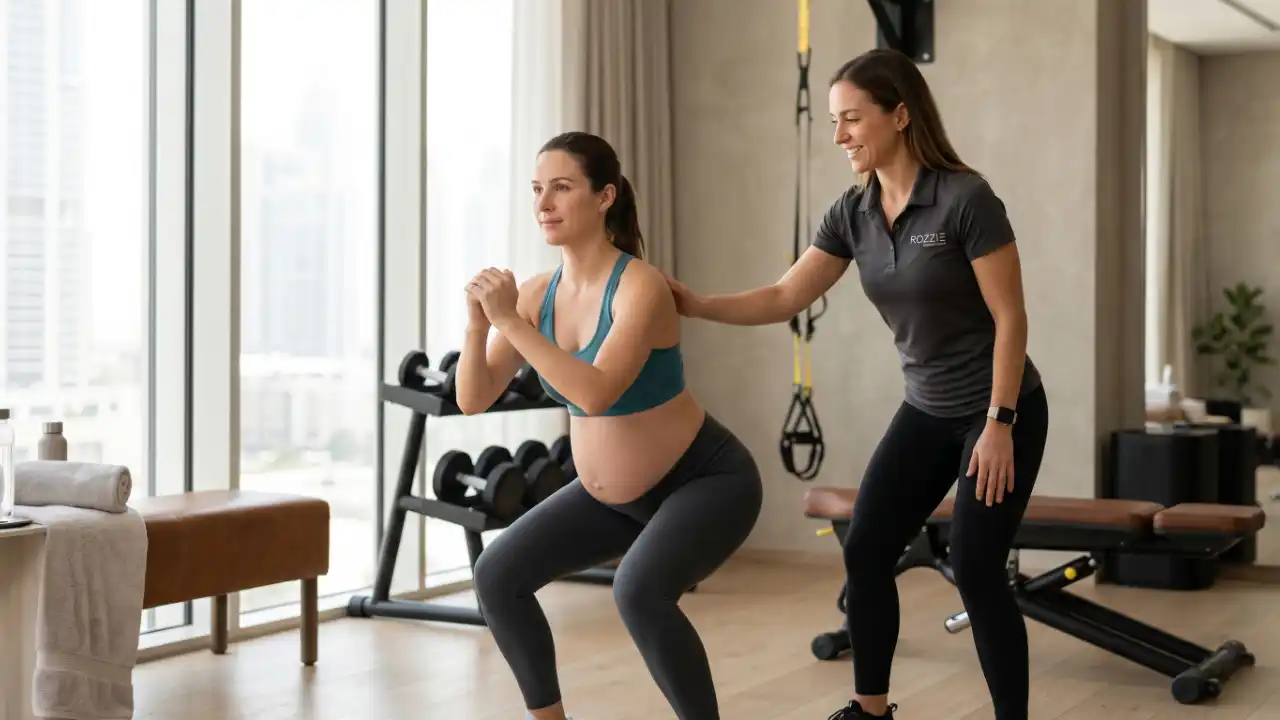
Focus on glutes, legs, upper back, shoulders, postural muscles, controlled squats, hip hinges, rows, carries, and supported single-leg work.
As your belly grows, your centre of gravity shifts forward. This can increase pressure on your lower back and change how your pelvis moves. Strong glutes, legs, and back muscles can help your body manage those changes more comfortably.
Simple rule: finish your session feeling strong, not exhausted.
3. Core Training Without Traditional Abs
You can train your core during pregnancy, but traditional abdominal exercises often need to be replaced.
Avoid movements that create unnecessary pressure through the midline, especially if you notice doming, coning, pulling, or discomfort.
Exercises to modify or avoid may include crunches, sit-ups, aggressive twisting, long front planks, and movements that create pelvic pressure or discomfort.
The focus should shift from “tight abs” to pressure management.
A safer core approach includes breathing mechanics, deep core activation, pelvic floor coordination, rib positioning, anti-rotation control, and supported stability exercises.
Simple breathing cue to use during strength exercises:
- Inhale: gently expand through your ribs, belly, and pelvic floor.
- Exhale: lightly lift the pelvic floor and draw the deep core inward.
This should feel controlled, not forced.
4. Pelvic Floor Training
Pelvic floor training is not only about doing more Kegels.
A functional pelvic floor needs both strength and relaxation. During pregnancy, your pelvic floor has to support extra load. During labour, it also needs the ability to relax and lengthen.
That is why prenatal pelvic floor work should include gentle contraction, full relaxation, breathing coordination, awareness of pressure, control during movement, and release work where appropriate.
A tense pelvic floor is not automatically a strong pelvic floor. Coordination matters.
5. Mobility and Posture Work
As pregnancy progresses, posture often changes. You may notice tighter chest and shoulders, more lower back tension, hip stiffness, pelvic discomfort, rib tightness, reduced rotation, or heavier legs.
Mobility work can help you feel more comfortable in daily life. Useful areas to focus on include hips, glutes, thoracic spine, chest, ankles, breathing expansion, and gentle spinal movement.
This is especially helpful if you sit for long hours, drive often, or work at a desk in Dubai.
Pregnancy-Safe Workout Example
This is a general example for a healthy pregnancy with medical clearance. It should be adapted to your trimester, fitness level, symptoms, and healthcare guidance.
Warm-Up – 5 Minutes
- Easy walking: Raises body temperature gradually and helps you check how your body feels that day.
- Shoulder rolls: Releases upper-body tension and prepares your posture.
- Hip circles: Helps mobilize the hips and pelvis before lower-body exercises.
- Cat-cow breathing: Encourages spinal mobility and connects breath with movement.
- Bodyweight squats: Prepares the legs and glutes with a controlled movement pattern.
Strength Circuit – 2 to 3 Rounds
- Supported Squat (8-12 reps): Builds leg and glute strength while helping you practise control, balance, and breathing. As your belly grows, use a wider stance if needed. Hold onto a stable surface for support.
- Incline Push-Up (8-10 reps): Strengthens the upper body without placing as much pressure on the front of the core as a floor push-up. Use a wall, bench, or elevated surface.
- Seated or Standing Row (10-12 reps): Builds upper-back strength, which helps support posture as your belly grows and your centre of gravity shifts. Focus on slow, controlled reps.
- Elevated Glute Bridge or Supported Hip Hinge (8-12 reps): Strengthens the glutes and posterior chain, which can help support the pelvis and lower back. If lying flat on your back feels uncomfortable, use an incline or choose a supported hip hinge instead.
- Pallof Press or Anti-Rotation Hold (8-10 reps per side): Builds deep core stability without crunching or twisting aggressively. The goal is control, not intensity.
Cooldown – 5 Minutes
Finish with hip mobility, chest opening, 360-degree breathing, pelvic floor relaxation, and slow nasal breathing. The session should leave you feeling more stable, not drained.
How Training Changes by Trimester
First Trimester – Fatigue, Nausea, and Consistency
In the first trimester, fatigue and nausea can be the biggest challenge. You may still be physically capable of many exercises, but your energy may be unpredictable.
Focus on gentle strength training, walking, mobility, breathing awareness, pelvic floor connection, avoiding overheating, and consistency over intensity.
In Dubai, overheating is especially important to manage. Avoid outdoor workouts during extreme heat and choose cool, well-ventilated environments.
Second Trimester – Posture, Core Pressure, and Stability
Many women feel more energetic in the second trimester, but movement mechanics start changing more noticeably. Your belly grows, your balance shifts, and your abdominal wall stretches.
Focus on glute strength, upper-back strength, supported lower-body exercises, deep core and pelvic floor coordination, pressure management, avoiding abdominal doming, and modifying supine exercises when needed.
This is often a good window to build a steady, sustainable routine.
Third Trimester – Comfort, Support, and Birth Preparation
In the third trimester, the goal shifts. Training should support comfort, circulation, strength, mobility, and preparation for birth and early motherhood.
Focus on shorter sessions, more rest, supported exercises, gentle strength work, hip and back comfort, breathing and pelvic floor relaxation, and movements that leave you feeling better.
Swimming can be especially helpful because the water reduces load on the joints and lower back. The best session is not the hardest one. It is the one that helps your body feel supported.
Need help adapting your workouts during pregnancy?
Every trimester can feel different, and your training should change with your body. If you are pregnant in Dubai and want a safe, structured plan, Fit with Rozzie offers personalized prenatal coaching built around your energy, symptoms, schedule, and medical guidance.
Movements and Risks to Avoid During Pregnancy
Some activities carry higher risk during pregnancy and should usually be avoided:
- contact sports
- activities with high fall risk
- hot yoga or overheated training environments
- heavy lifting with breath-holding
- exercises that cause abdominal doming or pelvic pressure
- exercises that cause pain, dizziness, or discomfort
- prolonged lying flat on your back from the second trimester onward, unless modified or medically approved
ACOG and NHS guidance both advise avoiding higher-risk activities such as contact sports, activities with a high risk of falling, scuba diving, and overheating. NHS guidance also notes that exercises lying on the back for longer periods should be avoided after around 16 weeks.
The goal is not fear. The goal is intelligent adaptation.
Warning Signs: Stop and Contact Your Doctor
Stop exercising immediately and contact your healthcare provider if you experience:
- vaginal bleeding or fluid leakage
- painful or regular contractions
- significant shortness of breath before exertion begins
- dizziness or faintness
- severe headache
- chest pain or sudden palpitations
- calf pain or sudden leg swelling
- significant reduction in fetal movement
These are not signs to push through. They are signs to stop and get medical advice.
Training in Dubai During Pregnancy: What to Consider
Dubai creates specific challenges for prenatal fitness. A generic online programme often ignores these details.
1. Heat and Dehydration
Dubai heat can make training more demanding, especially if you exercise outdoors or move between air-conditioned spaces all day. Air conditioning can also make you feel less sweaty than you really are, which may lead you to underestimate hydration needs.
During pregnancy, hydration matters even more because your body is supporting increased blood volume and amniotic fluid.
Practical tips: train indoors during hot months, avoid midday outdoor sessions, drink water before and after training, include electrolytes if advised by your healthcare provider, and stop if you feel dizzy, overheated, or unusually tired.
2. Busy Work Schedules and Stress
Many pregnant women in Dubai balance demanding jobs, long hours, commuting, family life, and social commitments. Your workout should not become another stressor.
A good prenatal plan should feel structured and calming. It should help your nervous system settle, not add more pressure. This is why shorter, well-designed sessions often work better than long, exhausting workouts.
3. Joint Laxity and Stability
During pregnancy, hormonal changes can make joints feel more mobile. This does not mean you are fragile. It means your exercise setup should be stable and controlled.
Prioritize supported positions, slower tempos, controlled ranges of motion, stable surfaces, clear technique, and exercises that feel secure. Avoid guessing your way through unstable or overly complex movements.
4. Home Training Can Be More Practical
For many pregnant women in Dubai, Home Personal Training is not just convenient. It can be the most realistic option.
It removes long commutes, crowded gyms, heat exposure before and after sessions, uncertainty around equipment, and the stress of adjusting everything alone. Training at home or in your building gym allows the plan to be adapted to your space, energy, trimester, and daily symptoms.
Common Mistakes Expectant Mothers Make
Mistake 1: Training Like Nothing Has Changed
Even if you were very fit before pregnancy, your body is changing. Your balance, breathing, joints, pelvic floor, abdominal wall, and recovery are not the same as before. You do not need to stop being strong. But you do need to train with more awareness.
Mistake 2: Avoiding Strength Training Completely
Walking is excellent, but it is not the whole picture. Your body still needs strong legs, glutes, back, shoulders, and postural muscles. Strength training can help support daily movement during pregnancy and early motherhood, especially lifting, carrying, feeding positions, and getting up from the floor.
Mistake 3: Following Random Social Media Workouts
Prenatal workouts online can look simple, but they may not be right for your body. Your trimester, symptoms, medical history, training background, energy level, and pelvic floor function all matter. A safe plan should be personal, not random.
Mistake 4: Ignoring Pressure Signs
Doming, coning, pelvic heaviness, leaking, pain, or pressure are signs that something needs to be adjusted. They do not mean you have failed. They mean your body is giving useful feedback. The right response is to modify the movement, change the breathing strategy, reduce load, or get professional guidance.
FAQ
Is it safe to exercise during pregnancy?
For most women with uncomplicated pregnancies, yes. Exercise is generally considered safe and beneficial when it is adapted properly and approved by your healthcare provider.
How often should I exercise while pregnant?
Many guidelines recommend aiming for around 150 minutes of moderate-intensity physical activity per week, spread across several days, if there are no contraindications. Your individual plan should still be adapted to your pregnancy and medical guidance.
Can I lift weights during pregnancy?
Yes, strength training can be appropriate during pregnancy when performed with good technique, controlled intensity, and proper modifications. Avoid maximal loads, breath-holding under heavy load, and movements that cause pain, pressure, dizziness, or abdominal doming.
Can I train my abs during pregnancy?
Yes, but traditional ab exercises often need to be modified or replaced. Focus on breathing, deep core control, posture, and pressure management rather than crunches, sit-ups, or aggressive abdominal work.
What exercises should I avoid during pregnancy?
Avoid contact sports, high fall-risk activities, hot environments, exercises that cause abdominal doming or pelvic pressure, and prolonged lying flat on your back from the second trimester onward unless modified or approved by your healthcare provider.
Is EMS training safe during pregnancy?
No. EMS training is not recommended during pregnancy. During pregnancy, safe traditional resistance training is the better approach. EMS Training may become an option postpartum only after full medical clearance and professional guidance.
Can I start exercising if I was inactive before pregnancy?
Often yes, but start gently and get medical clearance first. Walking, mobility, breathing work, and beginner strength exercises can be a good starting point when adapted properly.
Is home personal training a good option during pregnancy in Dubai?
Yes, for many women it is practical and comfortable. Home Personal Training in Dubai can reduce commuting, help avoid heat exposure, and allow each session to be adapted to your trimester, energy, symptoms, and available space.
Final Thoughts
Pregnancy is not a time to train out of fear. It is also not a time to push through every signal from your body.
The right approach is structured, calm, and intelligent.
You can build strength, support your posture, improve confidence, and prepare your body for birth and early motherhood without chasing intensity or following random online workouts.
A safe prenatal fitness plan should fit your body, your trimester, your medical guidance, and your real life in Dubai.
If you are pregnant and want personal support, Prenatal Personal Training in Dubai is built around your body, schedule, and stage of pregnancy.
Message me on WhatsApp to book a free prenatal consultation and build a plan that helps you train with more confidence and control.
Scientific Sources & Clinical References
- American College of Obstetricians and Gynecologists (ACOG): Physical Activity and Exercise During Pregnancy and the Postpartum Period
- American College of Obstetricians and Gynecologists (ACOG): Exercise During Pregnancy FAQ
- Royal College of Obstetricians and Gynaecologists (RCOG): Physical Activity and Pregnancy
- Mottola, M. F., et al. 2019 Canadian Guideline for Physical Activity Throughout Pregnancy. British Journal of Sports Medicine
- Davenport, M.H., et al. (2019). Impact of prenatal exercise on maternal harms, labour and delivery outcomes. British Journal of Sports Medicine. DOI: 10.1136/bjsports-2018-099821
- NHS: Exercise in Pregnancy
- NHS Best Start in Life: Exercising in Pregnancy