Last Update: May 2026 | Written by Rozzie Kinyua – Certified Personal Trainer in Dubai
Introduction
If you live in Dubai, you’ve probably seen the ads: “20 minutes of EMS replaces 90 minutes at the gym.” Studios are popping up across Marina, Downtown, and JLT, and Instagram is full of sculpted before-and-afters captioned with “just 2 sessions a week.”
So is EMS training the real deal – or is it just clever marketing wrapped in tight neoprene suits?
After years of training clients across Dubai with EMS, here’s my honest take: EMS works, but not the way most studios sell it. Let me explain what it actually does, who benefits most, and why some people should skip it entirely.
What EMS Training Actually Is
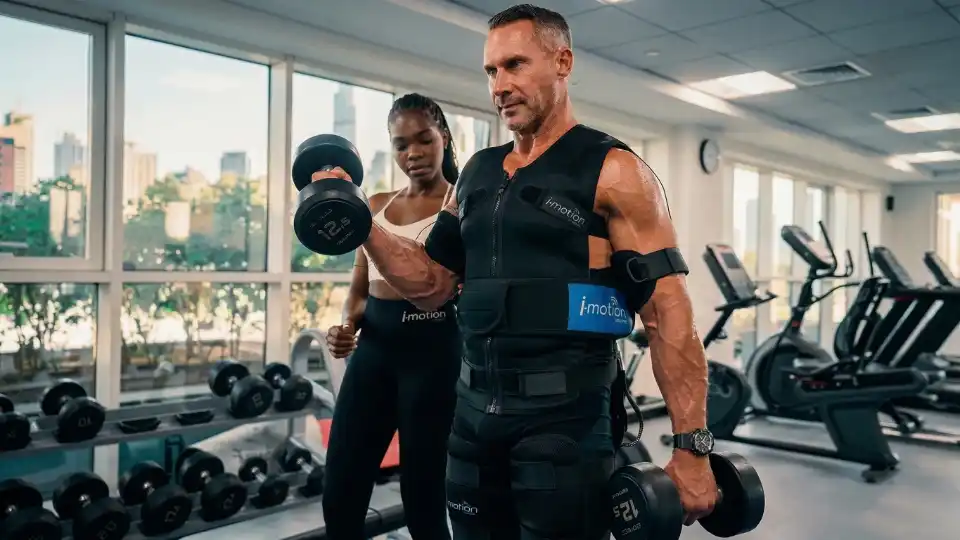
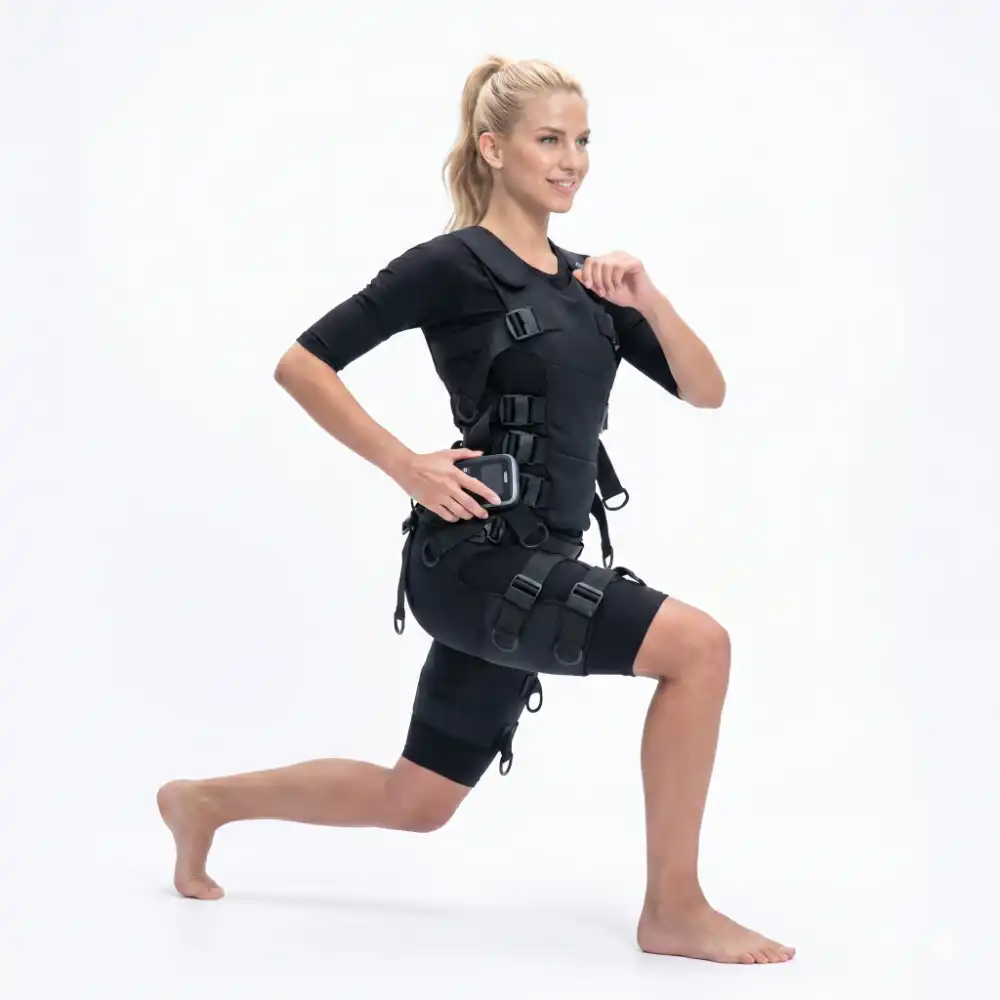
EMS stands for Electrical Muscle Stimulation. You wear a suit fitted with electrodes that send low-frequency electrical impulses to your major muscle groups while you perform basic movements – squats, lunges, presses, planks, simple cardio.
The impulses cause your muscles to contract more intensely than they would during normal training. In a regular squat, your brain recruits maybe 40-60% of the available muscle fibers. With EMS, the electrical signal forces a much higher recruitment rate – including the deep stabilizing fibers that are notoriously hard to activate, especially in the core, pelvic floor, and lower back.
That’s why a 20-minute EMS session leaves your muscles feeling like you trained for over an hour. You didn’t lift more weight – you simply activated more of what was already there.
Why EMS Has Exploded in Dubai
Dubai is the perfect market for EMS, and it’s not by accident:
1. Time-poor professionals. Most of my clients work 50+ hours a week. The promise of one focused 20-minute session beats spending 90 minutes commuting to a gym, training, and showering.
2. The heat. From May through September, outdoor cardio is brutal. EMS happens in air-conditioned spaces or even at your home – no excuses, no heat exhaustion.
3. Postpartum recovery. Dubai has a huge expat-mom community, often without family support nearby. EMS is one of the gentlest ways to rebuild deep core and pelvic floor strength after birth (with proper clearance – more on that below).
4. Joint-friendly intensity. The high muscle activation comes without heavy weights. For clients with knee, back, or shoulder issues, that’s a major win.
You are ready to experience the difference?
What the Science Actually Says
Let me separate what EMS does from what marketing claims:
Strongly supported by research:
- Significant Increase in Maximal Strength: WB-EMS (Whole-Body EMS) is scientifically proven to increase maximal strength and muscle mass. Studies show that the stimulus is comparable to traditional high-intensity resistance training, making it a viable alternative for hypertrophy.
- Source: Kemmler W, Teschler M, Weißenfels A, Bebenek M, Fröhlich M, Kohl M, von Stengel S. (2016) in PubMed Central
- Improved Core Strength and Posture: By simultaneously activating the deep stabilizing muscles of the trunk (like the transversus abdominis), EMS improves spinal stability and posture more effectively than many isolated floor exercises.
- Source: Ludwig O, Berger J, Becker S, Kemmler W, Fröhlich M. (2019) in PubMed Central
- Maximum Time-Efficiency: Research confirms that just 1–2 sessions of 20 minutes per week can yield measurable strength gains. This is due to the high density of muscle fiber recruitment (up to 90% of fibers activated simultaneously) which is difficult to achieve in a short time with conventional weights.
- Source: Kemmler W, Shojaa M, Steele J, Berger J, Fröhlich M, Schoene D, von Stengel S, Kleinöder H and Kohl M (2021) in Frontiers in Physiology
- Advanced Postpartum Recovery: For new mothers focusing on pelvic health, EMS has demonstrated superior results in strengthening pelvic floor muscles compared to performing Kegel exercises alone. This makes it a powerful tool for accelerating recovery and improving core stability after pregnancy.
- Source: Li J, Chen H, Gao C, Yang L, Lin S. in Taylor and Francis Online
- Targeted Relief for Chronic Back Pain: EMS is highly effective at reaching the deep stabilizing muscles of the back that are often missed during standard workouts. Studies have found that it reduces back pain intensity just as effectively as conventional training, but with a 43% to 62% lower time investment.
- Source: Micke F, Weissenfels A, Wirtz N, von Stengel S, Dörmann U, Kohl M, Kleinöder H, Donath L and Kemmler W (2021) in Frontiers in Physiology
- Healthy Aging & Metabolic Support: EMS is an excellent alternative for older adults who may find traditional heavy lifting challenging. Clinical trials have proven that consistent EMS sessions significantly increase muscle mass while simultaneously reducing abdominal fat in seniors.
- Source: Kemmler W, von Stengel S. (2013) – in PubMed Central
Partially supported:
- Body composition improvements (yes, but only combined with proper nutrition – same as any training)
- Fat loss (modest direct effect; the bigger effect comes from increased resting metabolism via more muscle)
Not supported by science:
- “Spot reduction” of belly fat or thigh fat – EMS can’t melt fat from specific areas any more than crunches can
- “20 minutes EMS = 90 minutes gym” – this is a marketing slogan, not a scientific equivalence. EMS is intense per minute, but it doesn’t replicate the cardiovascular conditioning of a longer workout
The Honest Summary: EMS is one of the most efficient tools I’ve seen for strength, posture, and deep muscle activation. It is a high-tech shortcut to a stronger foundation, but it is not a magic device that replaces a healthy lifestyle.
Realistic Results: What 12 Weeks Looks Like
When clients ask me what to expect from consistent EMS training in Dubai, here’s the honest timeline based on 2 sessions per week:
Weeks 1-4: Noticeable improvements in posture, core engagement, and how clothes fit. Strength gains in stabilizing muscles. Some initial soreness – EMS hits muscles you didn’t know you had.
Weeks 4-8: Visible muscle tone, especially in the back, glutes, and arms. Reduced lower-back pain in clients who came in with it. Clients tell me they feel “stronger in everyday life” – carrying kids, lifting groceries, walking long distances.
Weeks 8-12: Real body composition change if nutrition is in line. Without dialed-in nutrition, you’ll feel stronger and look more toned but won’t see dramatic fat loss.
This is the part most studios don’t tell you: EMS is a strength tool, not a diet replacement.
Who EMS Training Works Best For
Based on hundreds of sessions, these are the people who get the most out of it:
- Busy professionals who can realistically commit to 2 sessions per week and want maximum return per minute
- Postnatal women (cleared by their doctor, ideally 12+ weeks postpartum) needing to rebuild deep core and pelvic floor strength
- Older adults wanting joint-friendly strength training to maintain independence and prevent falls
- Beginners intimidated by gyms who want a guided, controlled introduction to resistance training
- Active people with chronic back, knee, or shoulder issues who can’t load heavy weights anymore
Who Should Skip EMS – Or Wait
EMS is not for everyone. I refuse sessions or recommend alternatives for:
- Pregnant women – full stop, regardless of trimester
- People with pacemakers, defibrillators, or other implanted electronic devices
- Epilepsy or unmanaged seizure disorders
- Acute injuries, recent surgery, or open wounds in the contact areas
- Severe cardiovascular conditions without medical clearance
- Anyone in the first 8-12 weeks postpartum without explicit doctor approval
If you fall into one of these categories, traditional…
is the safer route.
What EMS Training Costs in Dubai
EMS prices in Dubai vary widely. Studio sessions typically range from 250 to 500 AED per session, often with mandatory monthly memberships. Mobile EMS – where the trainer comes to your home or apartment gym – sits in a similar range but saves you the commute and gives you full attention rather than a shared studio experience.
The real question isn’t price per session – it’s price per result. Two private mobile sessions per week with a certified coach, paired with a clear nutrition plan, will outperform four sessions in a busy studio every single time.
How to Choose an EMS Trainer in Dubai
Three non-negotiables:
- Trained in EMS specifically – not just personal training. EMS has its own protocols, contraindications, and intensity management
- A proper consultation before the first session – health history, goals, contraindication screening
- Clear progression – if every session feels identical, you’re not progressing, you’re maintaining
Ask any potential trainer how they adjust intensity over a 12-week block, and how they integrate EMS with nutrition and lifestyle. If the answer is vague, keep looking.
My Verdict After Years of EMS Training in Dubai
EMS is neither a miracle nor a gimmick. It’s a precise, time-efficient tool that works exceptionally well for the right person – and is overhyped for the wrong one.
If you have 40 minutes a week, want functional strength rather than aesthetics-only goals, and pair it with sensible nutrition, EMS will likely become one of the most valuable parts of your routine. If you’re looking for a passive shortcut to a six-pack, no training method will deliver that, EMS included.
Frequently Asked Questions
Is EMS training painful?
EMS training is intense, not painful. Most clients describe the sensation as a deep contraction that feels strange during the first session and more normal after a few sessions. If it ever crosses into pain, the intensity is too high and should be reduced.
How often should I do EMS?
For many healthy adults, one to two EMS sessions per week can be a realistic frequency. More is not always better, because the muscles still need recovery. It is generally sensible to leave at least 48 hours between EMS sessions.
Can I combine EMS with regular gym training?
Yes. For many clients, combining EMS with regular training can work well. EMS can support deep muscle activation and strength work, while traditional training can support cardiovascular fitness, mobility, movement skill and progressive strength development.
Will I lose weight with EMS alone?
EMS alone is usually not enough for significant weight loss. It can support muscle activation and strength, but fat loss still depends mainly on nutrition, total activity, consistency and an appropriate calorie deficit.
Is EMS safe long-term?
For healthy adults, EMS can be safe when it is delivered by a trained professional, adapted properly and used with appropriate intensity and recovery. EMS is not suitable for everyone, including people with certain medical conditions, implanted electrical devices or during pregnancy.
How fast will I see results from EMS training?
Many clients notice posture, muscle activation or strength improvements within a few weeks. Visible muscle tone may take several weeks, and significant body composition change usually requires consistent EMS or training, nutrition structure and enough recovery over a longer period.
Curious Whether EMS Is Right for You?
I offer mobile EMS training across Dubai – at your home, in your apartment gym, or in my studio. Every package starts with a consultation to make sure EMS actually fits your goals, health history, and lifestyle. No pressure, no contracts you can’t exit.