Pilates and strength training can both make you fitter, stronger and more capable. But they do not produce exactly the same adaptations, and that matters when your training time is limited.
Maybe you want to build muscle. Maybe your priority is core strength, mobility, weight loss or staying strong as you get older. Or perhaps you already enjoy Pilates and are wondering whether you still need to lift weights.
The answer is not about choosing the trendier workout. It is about matching your training to what you actually want your body to become better at.
Quick Answer: Is Pilates or Strength Training Better?
Neither is universally better.
Choose strength training if your main goal is to build muscle, become significantly stronger, improve body composition or progressively challenge your muscles and bones.
Choose Pilates if your main priorities are core control, flexibility, balance, body awareness and controlled movement.
For many people, the best answer is not Pilates or strength training. It is a combination of both.
Strength training provides a clear way to progressively increase resistance as your body adapts. Pilates can complement that with focused core work, mobility, balance and movement control.
If you only have time for one and want the broadest foundation for long-term strength, muscle preservation and physical capacity, progressive strength training would usually be my first choice.
But that does not make Pilates ineffective. The better option depends on the result you are trying to create.
Pilates vs Strength Training: What Is the Difference?
Both methods make your muscles work, so the distinction is not as simple as “Pilates is stretching and weights are strength.”
There is considerable overlap.
The main difference is how each method is typically structured, how easily it can be progressed and which physical adaptations receive the greatest emphasis.
What Is Pilates?
Pilates is a low-impact exercise method centered around controlled movement, breathing, trunk stability, coordination and body awareness.
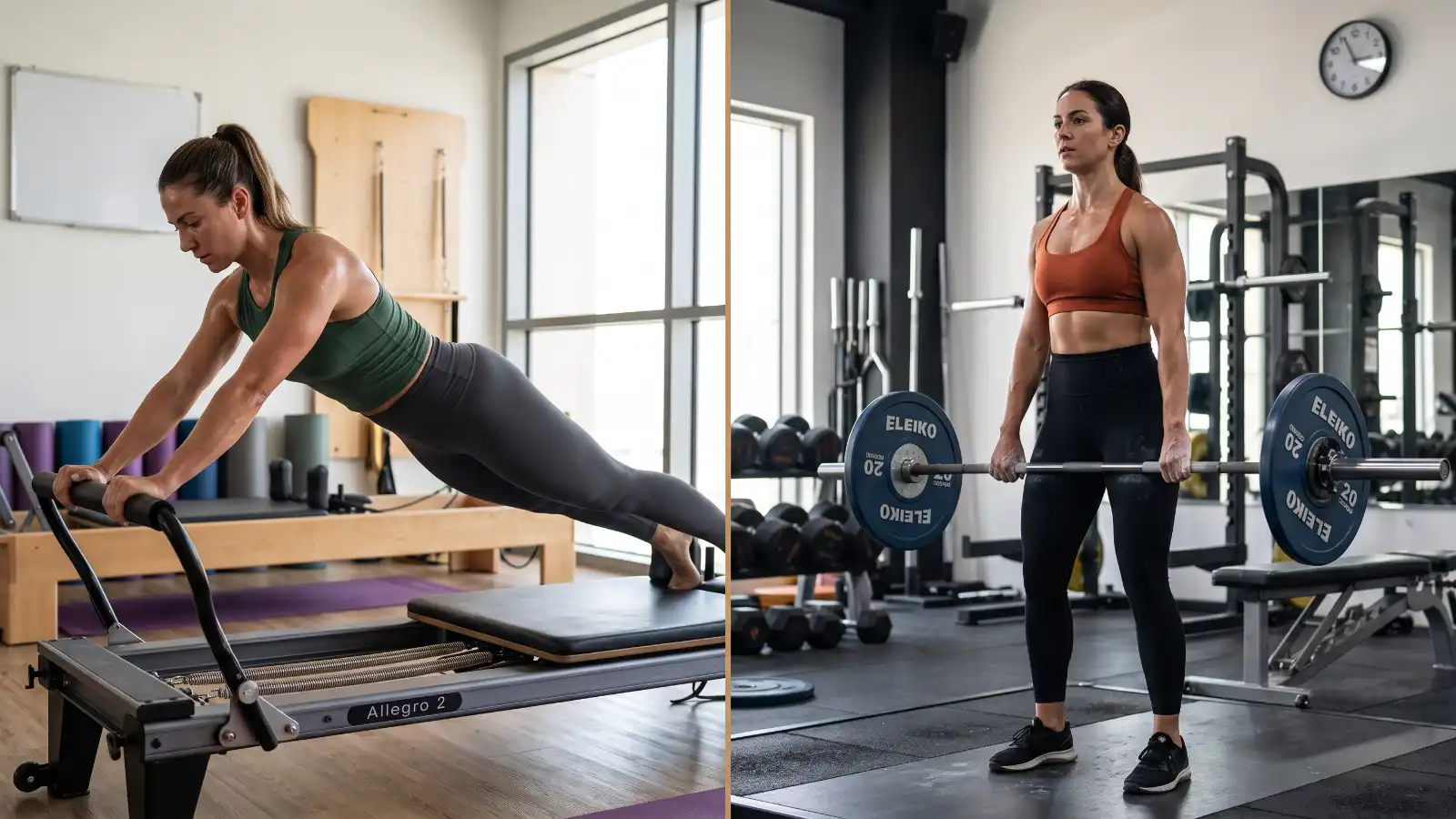
It can be performed on a mat using primarily body weight or with equipment such as a Reformer, which uses adjustable springs to create resistance.
A typical Pilates session may emphasize:
- trunk and pelvic control
- controlled spinal movement
- breathing coordinated with movement
- balance and coordination
- flexibility
- muscular endurance
- slow, deliberate movement
- awareness of body position
Pilates should not be dismissed as “just stretching.” Some exercises are physically demanding, and Reformer Pilates can provide meaningful resistance.
It can also complement training for both men and women who want additional work on mobility, trunk control and movement quality.
What Is Strength Training?
Strength training, also called resistance training, involves working your muscles against resistance.
That resistance can come from dumbbells, barbells, kettlebells, resistance bands, machines, cables or your own body weight.
The defining feature of a well-designed strength program is progression. As your body adapts, the training stimulus changes with it.
You might gradually increase the resistance, repetitions, sets, range of motion or difficulty of an exercise. This allows the training to keep challenging you instead of repeating exactly the same workload indefinitely.
ACSM’s updated 2026 Position Stand found that resistance training consistently improves muscular strength, hypertrophy, power, muscular endurance and several measures of physical function.
Pilates vs Strength Training at a Glance
| Goal | Better Fit | Why |
|---|---|---|
| Maximum strength | Strength training | Resistance can be progressively increased and measured |
| Muscle growth | Strength training | Greater control over load, volume and progression |
| Core control | Pilates | More dedicated emphasis on trunk and pelvic control |
| Flexibility and movement control | Pilates | These are central parts of the method |
| Bone loading | Strength training | Greater potential for progressive mechanical loading |
| Balance | Both | Both can train balance in different ways |
| Body composition | Strength training | Strong stimulus to maintain or build lean tissue |
| Healthy aging | Both | Strength plus mobility and balance is a strong combination |
These are general comparisons, not absolute rules.
A demanding Reformer Pilates session may provide more resistance than a very light gym workout. Likewise, a good strength program can include mobility, balance, full-range movements and substantial core work.
Programming matters more than the label placed on the workout.
Which Is Better for Your Fitness Goals?
Instead of asking which method wins overall, it is more useful to compare them against the outcome you actually care about.
Building Muscle and Strength
If your goal is to become noticeably stronger or build muscle, strength training is the more direct option.
Importantly, this does not simply mean “heavier weights equal more muscle.”
Research shows that muscle growth can occur across a range of resistance-training loads when the training stimulus is sufficient. Heavier loads appear to offer a clearer advantage when maximizing strength is the specific goal.
The main advantage of conventional resistance training is how precisely you can manipulate variables such as resistance, volume, repetitions, exercise selection and frequency.
For example, you might gradually progress from a 10 kg goblet squat to 14 kg and eventually 18 kg as your capacity improves.
Pilates can also challenge the muscles, especially if you are new to exercise. But if you eventually want to substantially increase strength or muscle mass in areas such as your legs, glutes, back or shoulders, traditional resistance training gives you considerably more room to progress.
If preserving muscle is particularly important while losing weight, you may also find our article GLP-1 and Strength Training: How to Protect Muscle useful.
Weight Loss and “Toning”
Neither Pilates nor strength training automatically causes fat loss.
Weight loss depends heavily on your overall energy intake, daily activity and consistency. Exercise supports that process, but it cannot completely compensate for nutrition that does not match your goal.
Strength training is particularly useful during fat loss because it provides a strong stimulus to maintain or build lean tissue.
When people say they want to look more “toned,” they are usually describing some combination of sufficient muscle development, lower body-fat levels and improved body composition.
Pilates can contribute through muscular endurance, posture awareness and movement quality. But there is no special type of “long, lean muscle” created by Pilates. Your muscles do not become physically longer because you choose Pilates instead of weights.
If nutrition is the part you find confusing, the Simplified Nutrition Guide explains everyday nutrition in a practical way without turning every meal into a calculation. The Fit with Rozzie Free Fitness Calculators can also help you estimate calories, protein requirements and other useful starting numbers.
Core Strength and Back Pain
This is an area where Pilates deserves real credit.
Core control is central to the method. Many exercises require you to coordinate breathing, pelvic position and trunk stability while moving your arms or legs at the same time.
Pilates has also been studied extensively in people with nonspecific low-back pain. A Cochrane review found evidence that Pilates can reduce pain and disability compared with minimal intervention in the short and intermediate term.
However, the same body of evidence did not establish that Pilates is consistently superior to other appropriate forms of exercise.
That distinction matters.
Pilates can be a useful exercise option for some people with nonspecific back pain, but it should not be promoted as a unique cure.
Strength training can also develop the muscles around the trunk, hips and back through movements such as rows, loaded carries, squats, hinges and unilateral exercises.
For many people, the useful long-term approach is therefore not choosing between “core work” and strength. It is gradually building both movement control and the capacity to tolerate greater physical demands.
If back pain is persistent, unexplained or worsening, speak with an appropriate healthcare professional or physiotherapist before beginning a new exercise program.
Flexibility and Mobility
Pilates generally has the advantage when flexibility and controlled movement are your main priorities.
Many exercises take the body through deliberate ranges of motion while maintaining control and positioning. Research in older adults has found positive effects on outcomes including balance, flexibility and physical function, although results vary between studies and outcomes.
Strength training can improve mobility too.
A squat performed through an appropriate range of motion does not only train strength. It also requires mobility at the ankles, knees and hips. The same principle applies to lunges, overhead presses, Romanian deadlifts and many other exercises.
This is why I do not view strength and mobility as opposites.
A well-designed training program can develop both.
Bone Health and Healthy Aging
This is one of the strongest reasons not to think of resistance training as exercise only for younger people.
Bones respond to mechanical loading. Progressive resistance training gives us a practical way to expose the musculoskeletal system to gradually increasing forces.
A systematic review and meta-analysis in older adults found that resistance training can positively influence bone mineral density, although the effect depends on factors including the training program, body site measured and individual.
Pilates contributes something different. Its focus on controlled movement and balance can be valuable as we age, particularly when maintaining confidence and physical function is the goal.
The two methods can therefore complement each other very well: Pilates can support balance and movement control, while progressive resistance training provides increasing muscular and skeletal loading.
Want to stay strong, mobile and confident as you get older?
Our Active Aging & Mobility Coaching in Dubai combines strength, balance and mobility work around your current ability, confidence and health background.
Can Pilates Replace Strength Training?
Sometimes, yes.
But it depends entirely on what you expect your exercise program to accomplish.
Pilates may be enough if your main goals are to move regularly, improve core control, increase flexibility, work on balance and enjoy low-impact exercise.
Not everybody needs to maximize muscle mass or chase a particular lifting number.
If your goals include building significant muscle, noticeably increasing strength, preserving muscle during weight loss or progressively loading your skeletal system, I would be much more reluctant to remove resistance training completely.
There is also an important middle ground.
Reformer Pilates uses external spring resistance, so it absolutely involves muscular force. A beginner performing challenging Pilates exercises may receive a meaningful strength stimulus.
The question is whether that stimulus can continue to progress enough for your specific goal.
The more specific the goal becomes, the more specific your training needs to become.
For women returning to exercise after childbirth, the decision can also require more context than simply choosing Pilates or weights. Early training may place greater emphasis on breathing, pelvic floor awareness, core control and gradual loading before progressing further into strength work.
Our Postnatal Training in Dubai follows that recovery-aware progression rather than treating Pilates or weight training as universally right from day one.
Should You Combine Pilates and Strength Training?
For many people, this is the best answer.
The two methods do not need to compete.
Strength training can provide progressive resistance, muscle development, measurable strength and greater physical capacity. Pilates can add focused work on core control, coordination, mobility, flexibility and balance.
The exact balance should reflect your priorities.
If strength and body composition are your main goals, spend more of your available training time on strength training. If you love Pilates, keep doing it.
Enjoyment matters because even the most evidence-based program only works when you can maintain it.
A simple week might look like:
Monday: Full-body strength training
Tuesday: Walking or normal daily activity
Wednesday: Pilates
Thursday: Rest or light mobility
Friday: Full-body strength training
Saturday: Pilates, walking or recreational activity
Sunday: Rest
If building muscle is a larger priority, you might choose three strength sessions and one Pilates session instead.
There is no universal perfect ratio.
The 2026 ACSM guidance reinforces an important point here: consistency and regular resistance training matter more for most adults than making the program unnecessarily complicated.
Pilates or Strength Training: Which Should You Choose?
If you only have time for one, start with the outcome that matters most to you.
Choose Pilates if you mainly want to:
- improve core control
- work on flexibility
- develop body awareness
- improve balance
- enjoy lower-impact exercise
- complement another training program
Choose strength training if you mainly want to:
- build muscle
- become noticeably stronger
- improve body composition
- preserve muscle during weight loss
- increase physical capacity
- progressively challenge your muscles and bones
- become stronger for everyday life
Choose both if you enjoy both and want a broader approach.
What About Women?
Women do not need fundamentally different exercise rules.
Strength training can help women build muscle, increase strength, support bone health and improve body composition. Lifting weights also does not automatically make women bulky.
Building substantial amounts of muscle requires consistent progressive training, appropriate nutrition and time.
Pilates can still be an excellent part of a woman’s routine. The mistake is assuming women should only perform light, “lengthening” exercise while heavier resistance is somehow inappropriate for them.
If that concern has stopped you from strength training, read Will Lifting Weights Make You Bulky? The Truth About Women & Weights.
What About Training After 40, 50 or 60?
As we get older, training becomes less about simply burning calories and increasingly about preserving what allows us to live independently and confidently.
Strength, muscle, balance and mobility all matter.
Pilates can support balance, flexibility and controlled movement. Progressive resistance training provides an additional opportunity to systematically challenge the muscles and maintain physical capacity.
You do not need to become a bodybuilder or train like an athlete.
Bodyweight exercises, resistance bands, dumbbells, machines and other forms of resistance can all be adapted to your ability.
The goal is to maintain the strength and movement capacity that support the life you want to live.
What About Training in Dubai?
There is also a practical consideration: where do you actually want to train?
Reformer Pilates usually requires access to specialized equipment, which commonly means attending a Pilates studio or having suitable equipment available at home.
Strength training can be more flexible.
With appropriate programming, effective resistance training can be done using dumbbells, resistance bands, bodyweight exercises or equipment already available in a villa or residential building gym.
Fit with Rozzie provides private personal training in Dubai at home, in villas and in suitable building gyms. The program can combine progressive strength work with mobility, balance and core training rather than forcing you into one rigid category.
Not sure whether professional coaching would actually add anything to your current routine?
Take our free 5-minute Personal Trainer Assessment to evaluate your training knowledge, consistency and where guidance may help.
Frequently Asked Questions
Does Pilates build muscle?
Yes. Pilates can stimulate your muscles and may improve strength and muscular endurance, particularly if you are a beginner or returning to exercise. If your goal is to maximize muscle development, progressive resistance training generally provides more options to systematically increase the training stimulus.
Is Pilates enough instead of weight training?
It can be, depending on your goals. If your priorities are general movement, core control, flexibility, balance and muscular endurance, Pilates may meet your needs very well. If you want significant muscle development, maximal strength or greater progressive skeletal loading, adding resistance training makes sense.
Is Reformer Pilates strength training?
Reformer Pilates uses external spring resistance, so it involves resistance and muscular force. Whether it provides enough progressive resistance for your particular strength or muscle-building goal depends on how the sessions are structured and progressed.
Is Pilates or strength training better for weight loss?
Neither automatically causes weight loss. Fat loss depends heavily on overall energy balance. Strength training can be particularly useful because it provides a strong stimulus to preserve or build lean tissue while losing weight.
Is Pilates better for your core?
Pilates places more deliberate emphasis on trunk control and core-focused movement than most traditional strength programs. However, many strength exercises also require significant trunk stabilization. Neither method has exclusive ownership of “core strength.”
Is Pilates good for back pain?
Pilates can improve pain and disability compared with minimal intervention in some people with nonspecific low-back pain. Current evidence does not establish Pilates as consistently superior to other appropriate forms of exercise.
Can I do Pilates and strength training in the same week?
Yes. They can complement each other very well. Your weekly balance should depend on your goals, available training time, recovery and which activities you enjoy.
Which is better for adults over 50: Pilates or strength training?
Both can be valuable. Pilates can support balance, flexibility and controlled movement, while progressive resistance training provides a particularly useful stimulus for maintaining muscle, strength and physical capacity. A combined approach can work extremely well.
Final Verdict: Pilates vs Strength Training
So, which is better?
Neither method wins every category.
But if I had to choose only one as the foundation for long-term strength, muscle preservation and physical capacity, I would choose progressive strength training.
It provides more opportunities to systematically increase the demands placed on your muscles and build measurable strength over time.
Pilates remains an excellent form of exercise. It can improve core control, flexibility, balance, coordination and body awareness. If you love Pilates, there is absolutely no reason to stop doing it.
The better question may be:
What does your current training program still need?
If you already do Pilates regularly but want to become stronger, add resistance training. If you already lift weights but want more mobility, body awareness or simply enjoy Pilates, adding a session can complement your program nicely.
The goal is not to win the Pilates vs strength training debate.
The goal is to build a body that is strong, mobile and capable, supported by a routine you can actually maintain.
Ready to find the right training approach for you?
Fit with Rozzie provides private personal training in Dubai with programs built around your goals, current ability, schedule and available training environment.
Prefer to explore first?
Take the free Do I Need a Personal Trainer? 5-Minute Assessment.
Scientific Sources
- American College of Sports Medicine. Resistance Training Prescription for Muscle Function, Hypertrophy, and Physical Performance in Healthy Adults. 2026 Position Stand.
https://acsm.org/resistance-training-guidelines-update-2026/ - Currier BS, et al. Resistance Training Prescription for Muscle Function, Hypertrophy, and Physical Performance in Healthy Adults. Medicine & Science in Sports & Exercise. 2026.
https://pubmed.ncbi.nlm.nih.gov/41843416/ - Lopez P, et al. Resistance Training Load Effects on Muscle Hypertrophy and Strength Gain: Systematic Review and Network Meta-analysis. Medicine & Science in Sports & Exercise. 2021.
https://pubmed.ncbi.nlm.nih.gov/33433148/ - Oliveira LS, et al. Effects of Pilates Exercises on Strength, Endurance and Muscle Power in Older Adults: Systematic Review and Meta-analysis. Journal of Bodywork and Movement Therapies. 2024.
https://pubmed.ncbi.nlm.nih.gov/38876695/ - Yamato TP, et al. Pilates for Low Back Pain: Complete Republication of a Cochrane Review. Spine. 2016.
https://pubmed.ncbi.nlm.nih.gov/26679894/ - Fernández-Rodríguez R, et al. Pilates Improves Physical Performance and Decreases Risk of Falls in Older Adults: A Systematic Review and Meta-analysis. Physiotherapy. 2021.
https://pubmed.ncbi.nlm.nih.gov/34332493/ - Massini DA, et al. The Effect of Resistance Training on Bone Mineral Density in Older Adults: A Systematic Review and Meta-analysis. Healthcare. 2022.
https://pubmed.ncbi.nlm.nih.gov/35742181/