Childbirth is one of the most demanding physical events your body can go through. Once your baby arrives, the focus often shifts almost completely to feeding, sleep, appointments and newborn care. Many mothers are left wondering what is actually safe for their own recovery.
You do not need to “bounce back” after birth. You need to rebuild safely.
Many new mothers feel pressure to return quickly to planks, crunches, running or intense workouts. But after pregnancy and birth, your deep core, pelvic floor, breathing mechanics, posture and energy may all feel different. That does not mean your body is weak. It means your body needs a progressive return to strength, not random workouts or pressure to rush.
Postpartum recovery is not a race. It is a rebuilding process. The goal is to reconnect your breath, deep core and pelvic floor first, then gradually restore stability, strength and confidence.
This guide walks you through five safe postnatal exercises that can help you begin that process with more clarity. They are not a replacement for medical care or pelvic floor physiotherapy, but they are a strong starting point once the movements feel comfortable and you have appropriate medical guidance.
Quick Answer: What Are the Best Postnatal Exercises to Start With?
The best early postnatal exercises usually focus on breathing, pelvic floor awareness, gentle deep core activation, hip strength and spinal mobility. Good starting movements include diaphragmatic breathing, pelvic tilts, heel slides, glute bridges and cat-cow.
Before returning to traditional core workouts, gym training or high-impact exercise, your first goal is to restore the connection between your breath, your deep abdominal muscles and your pelvic floor.
A safe postnatal exercise routine should follow three simple rules:
- Start with breath, pelvic floor awareness and gentle core control.
- Stop if you feel pain, pelvic heaviness, leaking, pressure or abdominal coning.
- Progress from awareness to stability, then strength, then impact.
The American College of Obstetricians and Gynecologists explains that postpartum exercise can usually be resumed gradually when medically safe, depending on delivery type and complications. It also notes that pelvic floor exercises may be started in the immediate postpartum period when appropriate.
Why Postpartum Recovery Needs a Different Approach
The desire to feel strong again after birth is completely understandable. But one of the most common mistakes new mothers make is jumping straight back into pre-pregnancy workouts, or following a generic fitness plan with no postnatal context.
Pregnancy changes the body in ways that are not always visible. The abdominal wall stretches. The pelvic floor carries increased load for months. Breathing mechanics can change as the ribs, diaphragm and abdominal wall adapt to pregnancy. Posture often shifts from carrying, feeding and holding a newborn.
The connective tissue between the abdominal muscles can also widen during pregnancy. This is commonly called diastasis recti. Some degree of abdominal separation is common after pregnancy, but the way you return to core training matters. Exercises that create too much pressure through the midline too soon can make symptoms harder to manage.
This is why postnatal exercise should not start with “harder is better.” It should start with control, precision and breath.
A helpful way to think about postnatal recovery is this:
- First, reconnect.
- Then, stabilize.
- Then, strengthen.
- Then, return to higher load or impact.
Skipping steps is where many setbacks begin.
If you trained during pregnancy, your return may feel smoother because you already know how to modify intensity and listen to your body. If you want to understand that earlier stage, our guide on training safely during pregnancy explains how prenatal training can support strength, breathing and confidence before birth.
Before You Start: Clearance, Symptoms and Red Flags
Gentle breathing and pelvic floor awareness may begin earlier for some women if they feel comfortable and have no medical concerns. But structured postnatal training should only begin once your doctor, midwife or qualified healthcare provider has cleared you, especially after a C-section, complications, significant bleeding, pelvic floor symptoms or pain.
ACOG notes that some women can resume physical activity within days of delivery, while others need more time depending on birth type and complications. That means there is no single perfect timeline for every mother. Your body, symptoms and medical history matter.
Stop the exercise and seek professional guidance if you notice:
- Pain in your pelvis, lower back, abdomen or scar area
- Pelvic heaviness or pressure
- Leaking urine during movement
- A dragging sensation
- Dizziness or unusual fatigue
- Increased bleeding
- Visible doming or coning along your abdominal midline
- A feeling that you cannot control your breath or pressure
These symptoms are common after birth, but they are signs that your body may need support, modification or assessment. You do not have to push through them.
If you have persistent leaking, heaviness, pain, prolapse symptoms or significant diastasis recti concerns, a pelvic floor physiotherapist should be part of your recovery team. A postnatal trainer can support movement, strength and progression, but physiotherapy is the right place for diagnosis and clinical pelvic floor assessment.
The 5 Safe Postnatal Exercises
The five movements below rebuild from the inside out. Each movement teaches your body an important skill for everyday motherhood: breathing, pressure control, pelvic stability, hip strength and spinal mobility.
Move slowly. Match each movement to your breath. Stop if the exercise creates pain, pressure, leaking or abdominal coning.
Movement 1: Diaphragmatic Breathing
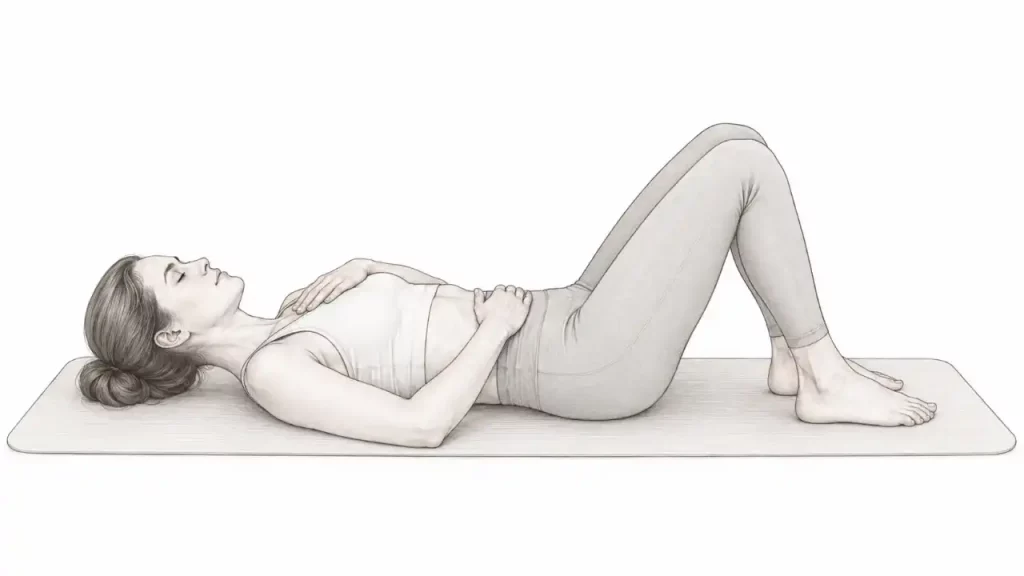
Diaphragmatic breathing is where postnatal recovery starts. Before you lift weights, attempt planks or return to high-intensity training, your body needs to reconnect the breath, deep core and pelvic floor.
During pregnancy, breathing mechanics often change as the baby grows and the ribs, diaphragm and abdominal wall adapt. After birth, it can take time to feel connected to your core again. Diaphragmatic breathing helps restore that connection gently.
How to do it:
Lie on your back with your knees bent and your feet flat on the floor. Place one hand on your chest and one hand on your lower ribs or belly.
Inhale slowly through your nose. Let your ribs expand out to the sides and slightly back, like an umbrella opening. Your chest should stay relatively quiet.
As you exhale, gently imagine your pelvic floor lifting and your lower belly softly drawing inward. Keep the effort light. This should not feel like bracing, gripping or forcing.
Repeat for 8 to 10 slow breaths.
What to feel:
You should feel gentle expansion on the inhale and soft connection on the exhale. You should not feel pressure bearing down into the pelvic floor.
Stop or modify if:
You feel pelvic pressure, dizziness, pain, scar discomfort or you find yourself gripping your abs aggressively.
Movement 2: Pelvic Tilts
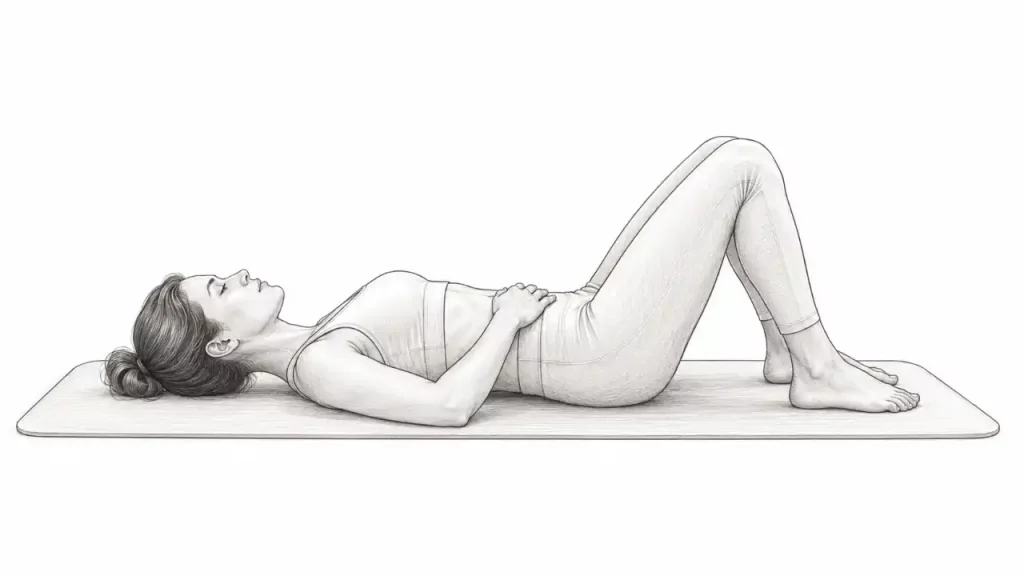
Once breathing feels calm and connected, pelvic tilts introduce gentle movement. They help restore awareness around the pelvis, lower back and deep abdominal muscles without asking the core to manage heavy load.
How to do it:
Lie on your back with your knees bent and your feet flat. Keep your shoulders relaxed.
Inhale to prepare. On your exhale, gently flatten your lower back toward the floor by slightly tilting your pelvis. Think of moving your tailbone just a little, not forcing a hard tuck.
Inhale and allow your pelvis to return to neutral.
Repeat for 10 to 12 controlled repetitions.
What to feel:
You should feel gentle lower abdominal engagement and a small controlled movement through the pelvis.
Stop or modify if:
You see doming along your abdominal midline, feel pressure downward, or feel pain in your lower back or pelvis.
Movement 3: Heel Slides
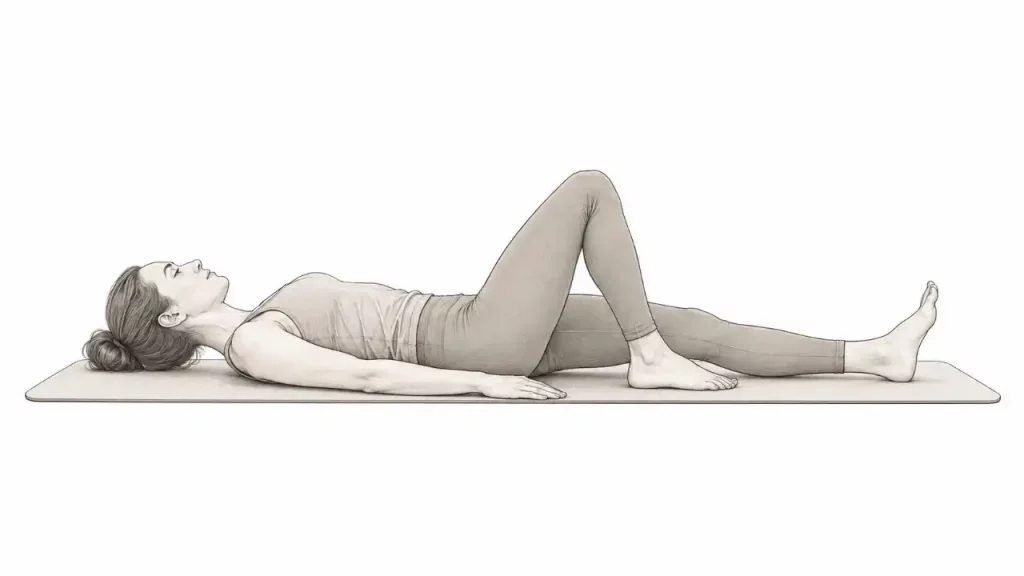
Heel slides teach your deep core to stay stable while your leg moves. That skill matters because real life with a baby involves constant limb movement: lifting, carrying, pushing a stroller, getting up from the floor and bending down.
How to do it:
Lie on your back with your knees bent and your feet flat. Take a gentle diaphragmatic breath in.
On your exhale, softly connect your pelvic floor and deep core. Slowly slide one heel along the floor until your leg is almost straight, only as far as you can control.
Inhale. On the next exhale, slide the heel back to the starting position.
Repeat 8 to 10 times per side.
What to feel:
Your pelvis should stay still. Your lower back should not arch away from the floor. Your breath should stay smooth.
Stop or modify if:
Your lower back arches, your abdomen cones, you hold your breath, or you feel pelvic heaviness.
Movement 4: Glute Bridges
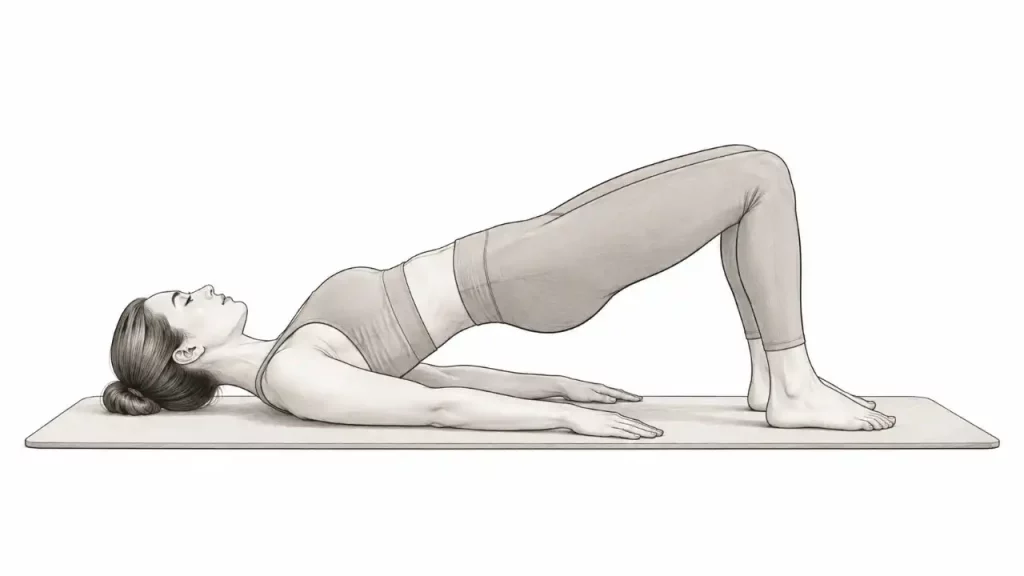
Glute bridges are a gentle way to reintroduce strength after birth. They help rebuild the hips and glutes, which support your pelvis and lower back during everyday movement.
This matters because many new mothers feel lower-back tightness from feeding, carrying and holding their baby. Stronger glutes can help share the load more effectively as you return to walking, stairs, lifting and later strength training.
A clinical review published through the National Library of Medicine highlights that postpartum recovery should consider posture, hip function, core control and gradual functional progression, not only abdominal exercises.
How to do it:
Lie on your back with your knees bent and feet hip-width apart.
Inhale to prepare. On your exhale, press through your heels and lift your hips until your body forms a straight line from shoulders to knees.
Pause at the top and gently squeeze your glutes. Inhale as you lower down slowly.
Repeat 10 to 15 times.
What to feel:
You should feel the effort mainly in your glutes and back of the hips, not your lower back.
Stop or modify if:
You feel lower-back compression, pelvic pressure, scar discomfort or abdominal coning.
If you are unsure whether these movements are right for your recovery stage, guided postnatal training in Dubai can help you rebuild safely with a plan adapted to your body, symptoms and medical guidance.
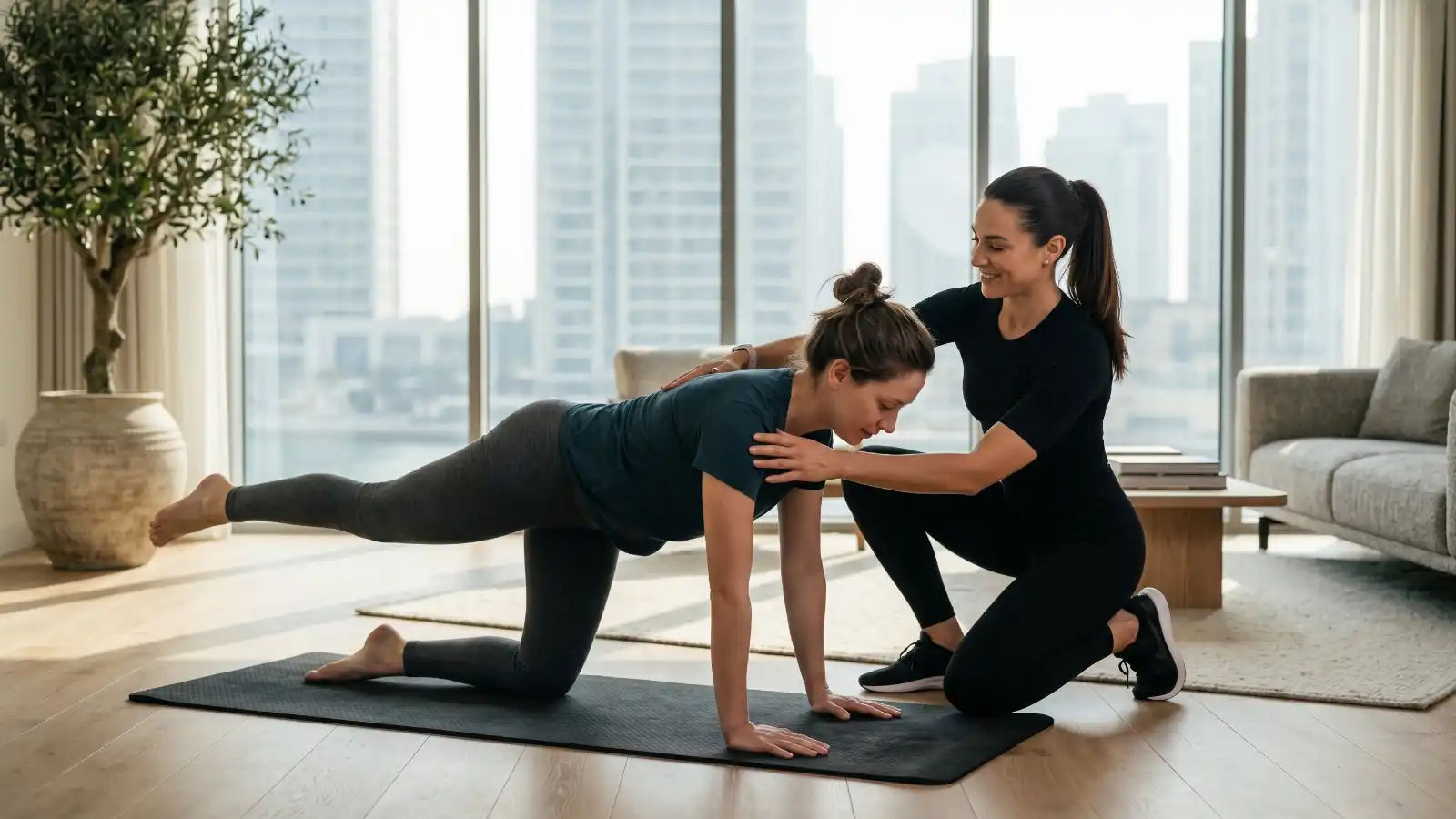
Movement 5: Cat-Cow
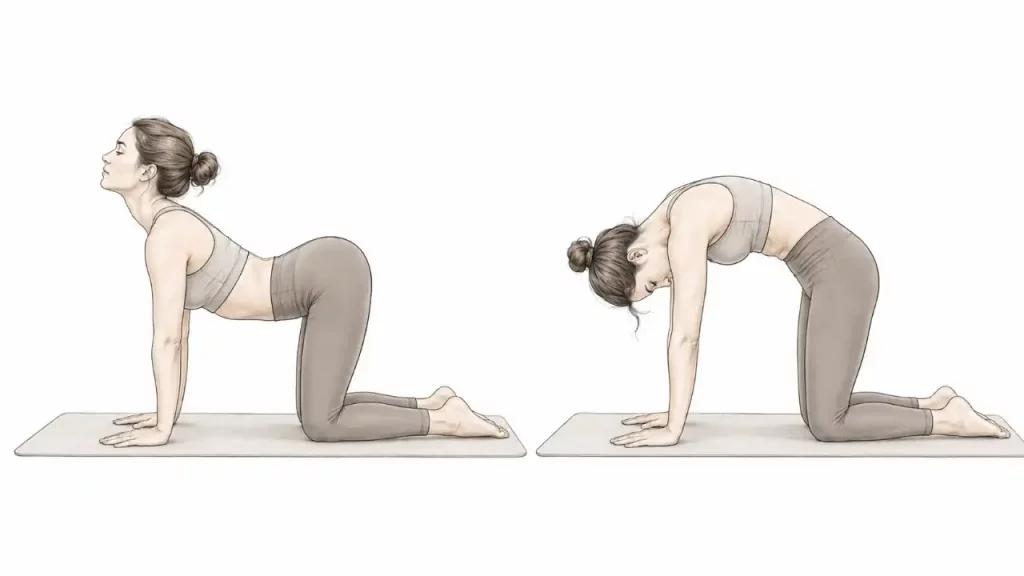
Cat-cow helps restore spinal mobility. It is especially useful after birth because feeding, carrying, rocking and comforting a newborn can leave your upper back rounded and your lower back stiff.
This movement gives your spine a gentle reset. It also helps you coordinate breath with movement, which supports better core control.
How to do it:
Start on your hands and knees with wrists under shoulders and knees under hips.
As you inhale, gently let your belly soften toward the floor, open your chest and look slightly forward.
As you exhale, press the floor away, round your spine toward the ceiling and let your head relax.
Move slowly for 8 to 10 breath-led cycles.
C-section modification:
If you had a C-section, keep the range very gentle at first. The rounding movement may feel uncomfortable around the scar area. Only increase the range as your comfort and healing allow, and follow your healthcare provider’s guidance.
Stop or modify if:
You feel pulling around the incision, abdominal pain, dizziness, pressure or discomfort.
What to Avoid in Early Postnatal Training
Early postnatal training is not about proving how much you can handle. It is about rebuilding the foundation that allows you to train safely later.
For now, avoid exercises that create more pressure than your deep core and pelvic floor can manage. This does not mean these movements are “bad forever.” It means they may not be appropriate yet.
Avoid or delay:
- Traditional crunches and sit-ups
- Long front planks
- Double leg lowers
- High-impact running and jumping
- Heavy lifting without breath and core control
- Exercises that cause abdominal coning or doming
- Exercises that trigger leaking, heaviness or pelvic pressure
The postnatal return-to-running guideline by Goom, Donnelly and Brockwell recommends that return to running should usually not be considered before around 12 weeks postpartum, and only when strength, pelvic floor function and symptoms are appropriate. You can read the full postnatal return-to-running guideline.
The key principle is simple: build awareness first, stability second, strength third and impact last.
Common Mistakes in Postnatal Recovery
Returning to pre-pregnancy workouts without assessment
What worked before pregnancy may not be right immediately after birth. Your body has changed, and your training should reflect that.
Ignoring symptoms
Leaking, heaviness, coning, pelvic pain or scar discomfort are not signs to push harder. They are signs to modify and get guidance.
Doing too much too soon
Sleep deprivation, breastfeeding demands, newborn care and emotional stress already create load. Exercise should support recovery, not compete with it.
Training only for weight loss
It is understandable to want to feel like yourself again, but early postnatal training should prioritize function first: breathing, pelvic floor control, posture, stability and strength.
Following generic postpartum plans
A downloadable plan cannot assess your scar, symptoms, diastasis recti, pelvic floor function or current recovery stage. Individual progression matters.
If your bigger challenge is not knowing how to stay consistent once life gets busy, our guide on how to build a fitness routine that actually sticks can help you create a realistic structure around work, family and recovery.
How Fit with Rozzie Supports Postnatal Recovery in Dubai
In Dubai, many new mothers struggle to find postnatal fitness guidance that is both safe and practical. Generic gym programmes often do not account for diastasis recti, pelvic floor symptoms, C-section recovery, sleep disruption or the logistics of caring for a newborn.
At Fit with Rozzie, your coach helps you rebuild strength with structure, care and individual progression. Sessions can take place at home, in your building gym or at a suitable private location, so you do not need to commute across Dubai just to restart safely.
Your programme can include safe postnatal strength training, breathing mechanics, pelvic floor awareness within training, mobility work, posture support and gradual progression back to full-body strength.
This is not about rushing your comeback. It is about helping you feel strong, capable and confident again, without guessing.
If your schedule as a new mother is already full, the principles in our article on personal training for busy professionals in Dubai also apply: the right plan has to fit your real life, not an ideal week.
Ready to rebuild safely after birth?
FAQ
How soon after giving birth can I start postnatal exercises?
Some gentle breathing and pelvic floor awareness may begin earlier if comfortable and medically appropriate. Structured postnatal training should begin only after clearance from your doctor, midwife or healthcare provider, especially after C-section, complications, heavy bleeding, pain or pelvic floor symptoms.
Are these exercises safe after a C-section?
Some of them may be appropriate with modifications, but C-section recovery needs extra care because it involves abdominal surgery. Breathing and gentle awareness work are often easier to start with. Movements such as cat-cow and bridges should be introduced gradually and only if they feel comfortable around the scar area.
What is diastasis recti?
Diastasis recti is a widening of the connective tissue between the two sides of the rectus abdominis muscles. It is common after pregnancy. The goal is not to panic about it, but to manage pressure well and rebuild core function progressively.
What exercises should I avoid with diastasis recti?
In early recovery, avoid exercises that create visible doming or coning along the abdominal midline. This often includes crunches, sit-ups, long planks, double leg lowers and heavy loaded movements before your core can manage pressure well.
Is leaking during exercise normal after birth?
Leaking is common after childbirth, but it is a sign that your pelvic floor may not yet be managing the load of the exercise. Reduce the intensity and seek guidance from a pelvic floor physiotherapist or qualified postnatal professional.
Can postpartum exercise help with back pain?
Postnatal training can help support posture, hip strength, mobility and core control, which may reduce some movement-related back discomfort. Persistent pain should be assessed by a healthcare professional.
Can I do postnatal training at home in Dubai?
Yes. Fit with Rozzie offers private postnatal training in Dubai at home, in building gyms or in suitable private training locations. This can make recovery easier to manage around newborn care, feeding and your daily routine.
Scientific Sources and Clinical References
American College of Obstetricians and Gynecologists. Physical Activity and Exercise During Pregnancy and the Postpartum Period.
https://www.acog.org/clinical/clinical-guidance/committee-opinion/articles/2020/04/physical-activity-and-exercise-during-pregnancy-and-the-postpartum-period
American College of Obstetricians and Gynecologists. Exercise After Pregnancy.
https://www.acog.org/womens-health/faqs/exercise-after-pregnancy
Selman R, Early K, Battles B, Seidenburg M, Wendel E, Westerlund S. Maximizing Recovery in the Postpartum Period.
https://pmc.ncbi.nlm.nih.gov/articles/PMC9528725/
Goom T, Donnelly G, Brockwell E. Returning to running postnatal: guidelines for medical, health and fitness professionals managing this population.
https://absolute.physio/wp-content/uploads/2019/09/returning-to-running-postnatal-guidelines.pdf