Fertility Series, Part 1 of 3: Movement
Quick Answer
Yes, gentle exercise is often possible during IVF, but your routine should change with your treatment stage. During ovarian stimulation, walking is a practical starting point; UCLH specifically recommends gentle exercise such as walking because the ovaries become enlarged. Running, jumping, heavy lifting and twisting movements need particular caution. After egg retrieval, allow time for recovery before returning to strenuous activity. After embryo transfer, routine bed rest is not recommended, although restrictions related to enlarged ovaries or complications may still apply. Your clinic’s individual instructions take priority. (UCLH, ASRM)
Why Exercise Advice Changes During IVF
If movement is part of your everyday life, starting IVF can make something familiar suddenly feel complicated. Can you still go to the gym? Should you pause your usual classes? And during the two-week wait, could an ordinary walk somehow be the wrong decision? These are understandable questions, especially when different websites seem to give different answers.
Part of the difficulty is that “exercise” covers everything from a gentle walk to a demanding strength session, while IVF itself involves several stages with different considerations. Before treatment, the conversation is about your usual routine. During stimulation, enlarged ovaries become an important concern. After retrieval, you need time to recover, and after transfer, the advice also depends on whether you have recently been through stimulation.
This IVF series from Fit with Rozzie explores three areas: movement, nutrition and recovery. This article focuses on movement. Part 2 covers what to eat during IVF and what to avoid, while Part 3 explores stress, sleep and coping during IVF. The aim is to help you make sense of the advice and keep a manageable routine, without turning exercise into another part of treatment you feel you have to get perfectly right.Phase 1: Before Your IVF Cycle Starts
Before your cycle begins, take a little time to discuss your existing routine with your fertility team. Explain what you actually do: perhaps you lift weights twice a week, enjoy running or attend a regular Pilates class. This gives you a useful starting point for deciding what can continue and what should change once stimulation begins.
If you have not been exercising regularly, there is no need to launch into an ambitious programme to prepare for IVF. Start with something manageable and leave room for recovery. A routine you can comfortably maintain and adapt will be easier to live with than one that already feels demanding before treatment starts.
What Does the Research Say About IVF Outcomes?
There are encouraging findings. A 2018 systematic review by Rao and colleagues found that physical activity before IVF or ICSI was associated with higher clinical pregnancy and live birth rates. A later review by Kakargia and colleagues, published online in 2022 and in print in 2023, also found a positive association with clinical pregnancy, while the findings for live birth remained uncertain. Much of the evidence was observational, which means it cannot show that exercise itself caused the better outcomes.
Some individual studies have also explored how much exercise women reported. A 2026 cohort study found the highest cumulative live birth rate in the group reporting exercise once or twice weekly or occasionally: 43.1%, compared with 37.2% in the no-exercise group and 37.1% in the more frequent exercise group. These outcomes included fresh and frozen transfers within one year of egg retrieval. However, activity was recorded before treatment, and exercise duration, intensity and type were not adequately captured. The study therefore does not establish that two sessions per week are ideal during IVF.
An older study by Morris and colleagues found lower odds of live birth in women reporting at least four hours of weekly exercise for one to nine years before IVF. That finding concerned a particular exercise-history subgroup; it does not establish a four-hour safety limit during treatment. Together, these studies give researchers useful questions to investigate, but they do not provide a weekly exercise prescription or prove that a coaching programme increases pregnancy rates.
What to Focus On Before Treatment
For your own routine, keep the priorities straightforward:
- Choose activities you enjoy and can maintain comfortably.
- Discuss your usual cardio and strength training with your fertility team.
- Leave enough room for recovery.
- Agree on how your routine should change when stimulation begins.
A coach can help you organise that plan and make adjustments along the way. There is no fitness deadline you need to meet before your first injection.
Phase 2: During Ovarian Stimulation
During stimulation, the developing follicles make your ovaries larger. This changes the exercise conversation, even if you still feel energetic and capable of your usual workout. Enlarged ovaries are more susceptible to ovarian torsion, a rare complication in which an ovary twists and its blood supply can be affected. Being fit does not remove that concern.
How to Adapt Your Activity
Walking is the clearest practical starting point during stimulation. UCLH recommends gentle exercise such as walking, while some specialists allow a broader range of modified activities. For example, reproductive endocrinologist Dr Amanda Adeleye describes an individual approach that can include stationary cycling, while advising changes to demanding exercise and movements involving sudden changes of direction. Recommendations differ between clinics, so check whether stationary cycling or light resistance training fits your individual treatment plan before continuing. (UCLH, Dr Amanda Adeleye)
A useful way to organise your routine is:
- Start with gentle movement: comfortable walking, within your clinic’s instructions.
- Pause demanding activities pending specific guidance: running, jumping, rapid changes of direction, deep twisting and heavy lifting or strong abdominal bracing.
- Check modified workouts individually: stationary cycling, resistance exercises, yoga and Pilates vary considerably in how they load and move your body.
Calling a workout “light” or keeping it short does not automatically make it suitable. If your clinic advises walking only, let that be enough for this stage. You do not need to find a substitute for every exercise you have paused.
What Newer Research Suggests
The PACE randomised trial, reported at ASRM in 2024, found a more favourable change in perceived stress among participants assigned to exercise during stimulation than among those advised to restrict activity. No ovarian torsion was reported in either group, but the study was too small to establish whether exercise changes the risk of this rare complication. These preliminary findings support further research and a more individual discussion about activity; they do not establish that unrestricted training is safe.
Ask Your Clinic a Specific Question
It can be difficult to get a useful answer to “Can I exercise?” because that could mean so many different things. Try describing your actual routine instead:
Phase 3: Around Egg Retrieval
For egg retrieval day, plan around the procedure and getting home to recover. Follow your clinic’s preparation and discharge instructions, including any advice related to sedation. This is a good time to leave your training schedule open rather than planning a workout you may feel obliged to complete.
Recovery varies. You may feel comfortable with a little gentle walking relatively soon, or you may need more time because of bloating, discomfort or fatigue. Light activity can be appropriate, while strenuous exercise should wait until your clinic is happy with your recovery. A fixed return-to-training date is less useful than a plan based on your symptoms and clinical assessment. (Pacific Fertility Center Los Angeles)
Feeling better also does not necessarily mean your ovaries have returned to their usual size. Ask when any remaining restrictions should be reviewed, particularly if you are moving straight into a fresh embryo transfer. (Mayo Clinic)
If You Develop OHSS
If you develop ovarian hyperstimulation syndrome, or OHSS, your clinic should guide your activity, fluid intake and monitoring. With mild OHSS, gentle activity may be advised to help reduce blood clot risk, while strenuous exercise should be avoided when the ovaries are enlarged and painful. Worsening symptoms need medical advice rather than simply more rest at home. (RCOG patient information)
Phase 4: After Embryo Transfer and During the Two-Week Wait
After embryo transfer, ordinary decisions can start to feel unusually important. You might find yourself wondering whether to take the stairs, go for a walk or spend more time lying down. One clear piece of reassurance is that ASRM recommends against routine bed rest after embryo transfer.
You can still rest because you are tired or would enjoy a quiet afternoon. The distinction is that lying still is not something you need to do to help implantation. Your activity plan should account for your recovery and any complications, rather than treating the transfer itself as a reason to stay in bed.
Fresh and Frozen Embryo Transfers Can Need Different Advice
Following a fresh transfer, you have recently been through stimulation and egg retrieval, so ovarian enlargement and recovery may still affect what you can do. With a frozen transfer that does not follow recent stimulation, those particular restrictions may no longer be relevant. However, the transfer protocol, symptoms and any ovarian cysts still matter. (Mayo Clinic, clinical discussion of ovarian torsion following frozen embryo transfer)
Fresh embryo transfer
- Follows recent stimulation and egg retrieval.
- Enlarged ovaries and recovery can still limit exercise.
- Activity advice needs to account for symptoms and OHSS risk.
Frozen embryo transfer
- May take place after recovery from an earlier retrieval.
- Stimulation-related ovarian enlargement may no longer be a concern.
- Activity advice still depends on the protocol, symptoms and ovarian findings.
A Practical Approach to the Waiting Period
Keep to the activities agreed with your clinic: ordinary daily tasks and comfortable walks may fit, while structured workouts may need to remain modified or paused. There is no need to chase a step target or make up for missed training.
Research using wearable activity trackers in the observational SSTEP study found no association between measured activity and pregnancy outcomes around programmed frozen embryo transfers. This adds useful evidence, but it does not establish an ideal exercise programme or demonstrate that every exercise intensity is safe.
Phase 5: After Your Pregnancy Test
If You Are Pregnant
If your test is positive, check how your exercise plan should change from here. After a fresh cycle, your ovaries may still be enlarged and treatment-related restrictions may continue for a while, so moving immediately into a standard prenatal programme may be premature.
Once your team is happy for you to follow general pregnancy exercise guidance, you can discuss how to adapt your activities as pregnancy progresses. If you would like ongoing support, Fit with Rozzie offers prenatal personal training in Dubai.
If the Cycle Does Not Work
If the cycle does not work, you may want the familiarity of your usual routine, or you may not feel ready to think about exercise at all. Both deserve room. Check whether any physical restrictions remain, then return gradually when you feel ready rather than expecting yourself to pick up exactly where you left off.
Physical readiness and emotional readiness do not always arrive together. If you would find it helpful to talk to someone, your fertility clinic can also help you access counselling or other appropriate support.
Training in Dubai During IVF
Choose a comfortable environment. An air-conditioned space or a walk during a cooler part of the day may make gentle movement easier to manage. Once you are pregnant, NHS guidance specifically advises avoiding strenuous exercise in hot weather and drinking enough fluids. (NHS)
Keep hydration practical. Have water available, and follow any specific fluid instructions from your clinic if you develop OHSS. Drinking according to an individual care plan is more useful than trying to meet an arbitrary target. (RCOG)
Make the location work for you. Training at home or in your building gym can reduce travel when your week already includes appointments, work and other commitments. Convenience can make an adjusted routine easier to maintain.
Leave room for changes. Monitoring appointments, symptoms and updated clinical advice may affect what feels manageable from one day to the next. A flexible plan lets you change or postpone a session without feeling you have fallen behind.
Share what you are comfortable sharing. You decide how much personal information to discuss with your coach. What they do need to understand is which activities have been approved, which restrictions apply and when those instructions change.
How Fit with Rozzie Supports You During IVF
During treatment, support can be as practical as having someone help you adjust a familiar routine. At Fit with Rozzie, our three pillars of nutrition, movement and recovery provide a way to organise that support around everyday life and the guidance from your fertility team.
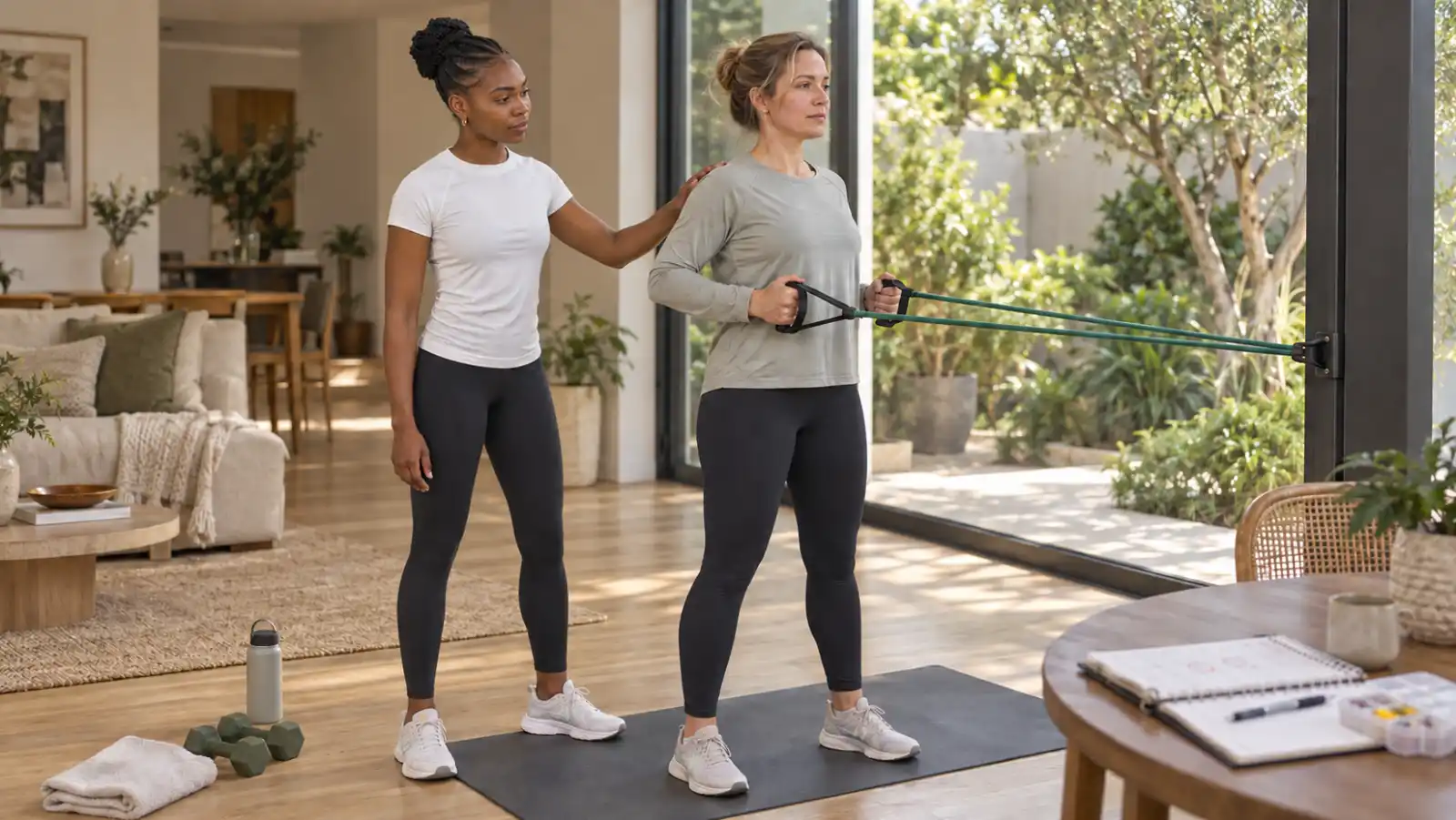
For exercise, this means working within the activities your clinic has approved, adapting sessions around appointments and recovery, and reviewing the plan when your instructions change. If walking is all that has been advised, the plan should respect that. There is no need to turn a temporary change in training into a problem to solve.
Personal training can provide structure, encouragement and a familiar routine during treatment. It is not a medical treatment, and we do not claim that our programme increases pregnancy or live birth rates. The focus is on practical support that fits your circumstances.
You can explore our female personal training in Dubai, learn about nutrition coaching or view our coaching options and prices. If you would like to talk it through, message Rozzie on WhatsApp. A useful starting point is simply where you are in treatment, what your clinic has advised and what kind of support you would find helpful.
Frequently Asked Questions
Does Exercise Improve IVF Success Rates?
Physical activity before IVF has been associated with higher clinical pregnancy rates in research reviews, while findings for live birth are less consistent. These findings are encouraging, but much of the evidence is observational. They do not prove that exercise causes better outcomes or that a particular personal training programme increases your chances.
How Much Exercise Is Too Much During IVF?
During stimulation, prioritise gentle activity such as walking and scale back demanding workouts. There is no validated weekly hour limit for IVF: the often-cited four-hour finding concerns a specific exercise-history subgroup, and a newer study’s favourable results with once- or twice-weekly activity do not establish an ideal treatment schedule. Your treatment stage and the activity itself matter more than meeting a numerical target.
Should I Stop Lifting Weights During IVF?
Pause heavy lifting during stimulation until you have specific guidance about what you can continue. Light resistance work also needs to fit your clinic’s instructions; reducing the weight or increasing repetitions does not automatically make an exercise appropriate. After retrieval, wait for advice on resuming strength training.
Can I Do Yoga During IVF?
You may need to modify or pause your usual yoga practice during stimulation and recovery. Yoga can include deep twists, demanding abdominal work and vigorous sequences, so the type of class matters. Describe the actual movements to your clinic rather than relying on the label “gentle yoga.”
Is Walking After Embryo Transfer Safe?
Gentle walking is generally compatible with advice against routine bed rest after embryo transfer. Keep it comfortable and follow any restrictions related to recent retrieval, ovarian enlargement or OHSS. You do not need a daily step target to support implantation.
Is Exercise Advice Different for a Frozen Embryo Transfer?
Yes, it can be. A frozen transfer without recent stimulation may not involve the same ovarian enlargement as a fresh cycle. Your transfer protocol, symptoms and any ovarian findings still need to be considered when deciding whether to continue structured workouts.
Can Exercise Cause Ovarian Torsion During IVF?
Enlarged ovaries during fertility treatment are more susceptible to torsion, which is why certain activities may be restricted. Research does not reliably quantify the risk from individual exercises or establish a safe intensity threshold. Sudden severe pelvic pain, particularly with nausea or vomiting, needs urgent assessment.
Should I Exercise Between IVF Cycles?
A gradual return to familiar exercise can be reasonable once you have recovered and your clinic has lifted any restrictions. Start at a level that feels manageable and adjust around your next treatment plan. You do not have to return immediately to your previous training volume.
Continue the Series
This article provides general information and does not replace personalised advice from your fertility team. Follow your clinic’s instructions for your treatment and recovery.
Scientific Sources and Clinical Guidance
- Rao et al. (2018). Maternal physical activity before IVF/ICSI cycles improves clinical pregnancy rate and live birth rate: a systematic review and meta-analysis. Reproductive Biology and Endocrinology.
- Kakargia et al. (2023; published online in 2022). Systematic review and meta-analysis examining physical activity and assisted reproduction outcomes. Archives of Gynecology and Obstetrics.
- Geiger et al. (2026). Impact of maternal physical activity on outcome of assisted reproduction. Retrospective cohort study; activity was assessed before treatment. Frontiers in Endocrinology.
- Morris et al. (2006). Effects of lifetime exercise on the outcome of in vitro fertilization. Obstetrics & Gynecology / PubMed.
- PACE trial (ASRM 2024 presentation). Preliminary randomised trial findings on exercise during ovarian stimulation. Trial registration and Healio conference report. The conference report is a secondary account of the findings.
- SSTEP study (2026; published online in 2025). Observational research using wearable trackers around programmed frozen embryo transfer. Fertility and Sterility / PubMed.
- ASRM (2017). Performing the embryo transfer: a guideline. Includes the recommendation against routine bed rest after transfer. ASRM guideline.
- RCOG (2026). The Management of Ovarian Hyperstimulation Syndrome, Green-top Guideline No. 5. Clinical guideline.
- RCOG. Ovarian hyperstimulation syndrome. Patient information.
- UCLH Reproductive Medicine Unit. Exercise advice during fertility treatment. Patient FAQs.
- Yale Medicine. Ovarian torsion: risk factors, symptoms and treatment. Clinical information.
- Dr Amanda Adeleye. Exercise during fertility treatments, what is the verdict? An individual specialist’s clinical perspective. Article.
- Pacific Fertility Center Los Angeles. Egg retrieval and recovery guidance. Patient guide.
- Mayo Clinic. In vitro fertilisation: procedure and recovery information. Patient guide.
- Frozen embryo transfer case report (2024). Ovarian Torsion at 8 weeks of Gestation in a Woman with Threatened Abortion After Frozen-Thawed Embryo Transfer. Illustrates why protocol and ovarian findings matter; it does not establish how commonly this occurs. International Journal of Women’s Health.
- NHS. Exercise in pregnancy, including hot-weather precautions. Pregnancy guidance.