When parents hear the words “strength training for kids,” they often picture a child lifting a heavy barbell in an adult gym.
That is not what appropriate youth strength training should look like.
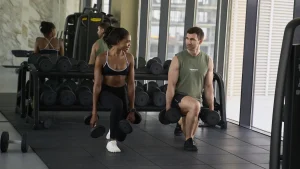
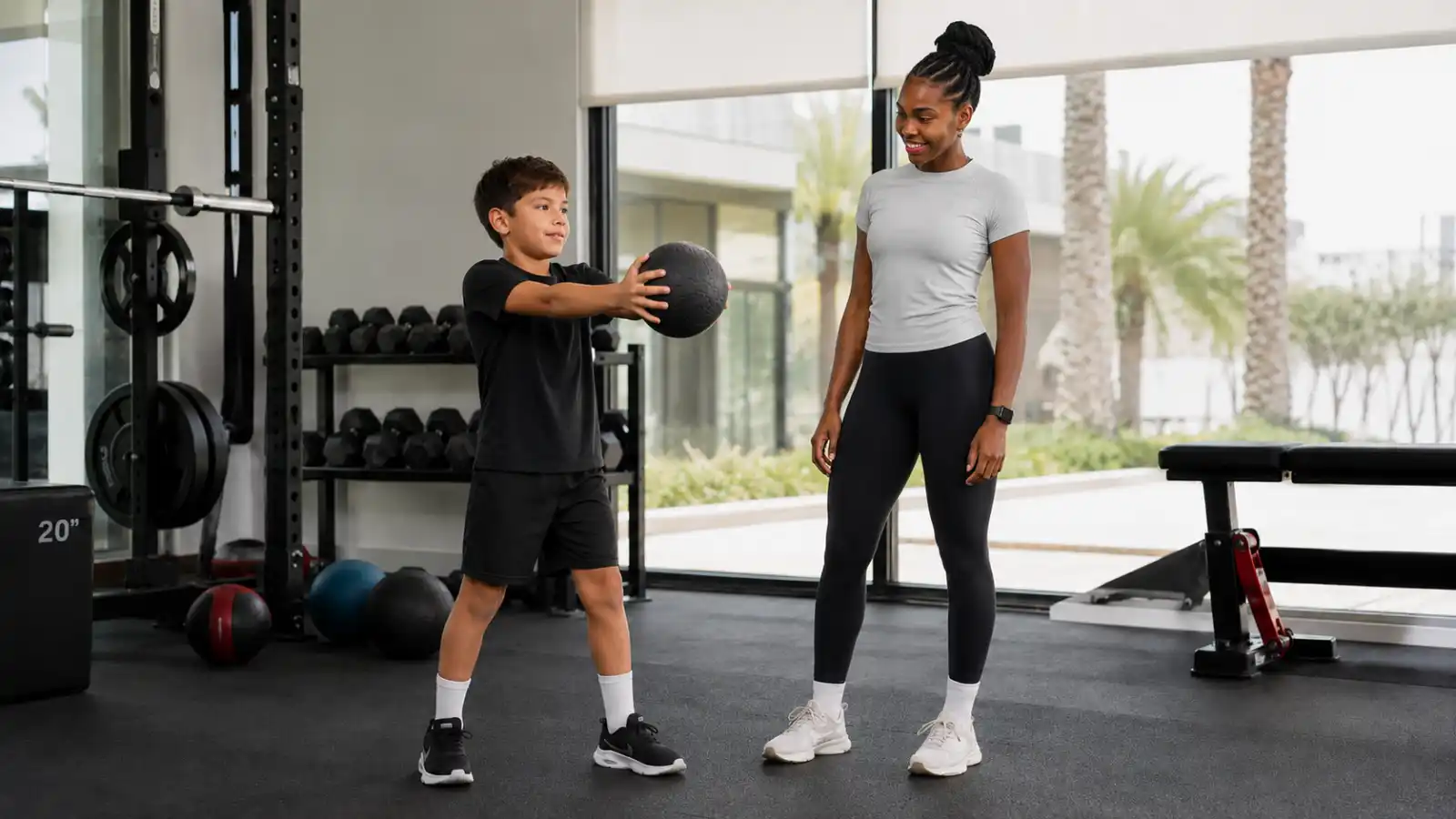
For children, strength training can include bodyweight exercises, resistance bands, medicine balls, light dumbbells, balance work, climbing, jumping and controlled movements that help them become stronger and more confident.
As more parents in Dubai look for structured fitness support for their children – whether at home, in a villa gym or alongside another sport – one question comes up repeatedly: is strength training actually safe for a growing child?
The answer depends less on the presence of weights and more on how the programme is designed, supervised and progressed.
Quick Answer: Is Strength Training Safe for Kids?
Yes. Properly supervised, age-appropriate strength training is generally considered safe for children and teenagers.
The American Academy of Pediatrics states that resistance training can be part of a healthy physical activity programme when children receive qualified instruction, use appropriate technique and follow a programme suited to their developmental level. Its clinical report on resistance training for children and adolescents was reaffirmed in November 2024.
Strength training for children should not be based on bodybuilding, punishment workouts or lifting the heaviest weight possible.
A safe programme focuses on:
- learning how to move well
- developing balance and coordination
- using manageable resistance
- progressing gradually
- receiving real-time supervision
- keeping the experience positive
When those principles are followed, strength training can help children develop useful physical skills without placing unnecessary pressure on their bodies or turning exercise into a performance test.
What Does Strength Training Mean for Children?
Strength training is any activity in which the muscles work against resistance.
That resistance may come from the child’s own bodyweight, a resistance band, a light dumbbell, a medicine ball, a cable machine, a partner exercise or even a controlled carrying task.
Examples may include:
- squats to a bench
- lunges or split squats
- wall or elevated push-ups
- resistance-band rows
- crawling and climbing
- light carries
- medicine-ball throws
- controlled jumps and landings
- balance exercises
This is different from bodybuilding, powerlifting or competitive weightlifting. Those activities have their own goals and technical demands.
For most children, the first objective is not muscle size or a heavy number on the bar. It is movement quality, coordination, body control and confidence.
How do children become stronger without “bulking up”?
Before puberty, most strength gains come from improved coordination and more efficient activation of the muscles rather than large increases in muscle size.
The nervous system becomes better at recruiting the right muscles at the right time. A child may therefore become noticeably stronger and more controlled without developing an adult-looking muscular physique.
During and after puberty, increases in muscle size can play a larger role, but training outcomes still depend on development, genetics, nutrition, programme design and consistency.
Are bodyweight exercises always better than weights?
Bodyweight exercises are often useful, but they are not automatically safer or easier.
A full push-up, pull-up or single-leg squat may be far more demanding than a light dumbbell press or resistance-band row.
The best exercise is the one the child can understand, control and perform with suitable technique. The tool matters less than the quality of the instruction and the appropriateness of the challenge.
Does Strength Training Stunt a Child’s Growth?
There is no evidence that a properly designed resistance-training programme reduces a child’s final height or stops normal linear growth.
The concern usually centres on growth plates, which are developing areas of tissue near the ends of children’s bones. Growth plates can be injured, but their existence does not mean that children must avoid all resistance.
Running, jumping, landing, changing direction, gymnastics and contact sports also place forces through a developing skeleton.
The relevant question is whether the force is appropriate, controlled and introduced gradually.
The National Strength and Conditioning Association reports that prospective studies using age-appropriate programming and qualified supervision show a low risk of injury. The American College of Sports Medicine similarly describes youth resistance training as safe and effective when it is supervised, well designed and driven by technique.
Problems are more likely when children:
- train without supervision
- use unsuitable equipment
- lift more than they can control
- copy advanced adult programmes
- progress too quickly
- play around near unsecured weights
- continue despite pain
In other words, strength training itself is not automatically the risk. Poor coaching, unsuitable loading and an unsafe environment are the more important concerns.
No physical activity is completely risk-free. Children can also be injured while playing football, cycling, climbing or participating in gymnastics.
The aim is not to remove every physical challenge. It is to manage the challenge appropriately.
What Are the Benefits of Strength Training for Kids?
The most obvious benefit is improved strength, but a well-designed programme can support several other areas of development.
Potential benefits include:
- better balance and coordination
- improved body awareness
- stronger movement foundations
- better control when running, landing and changing direction
- greater confidence during sport and physical activity
- stronger muscles and bones
- improved general physical capacity
- positive long-term exercise habits
Strength and neuromuscular training may also help reduce certain sports-related injuries when it is appropriately integrated into a child’s wider training. The evidence supports well-designed programmes rather than the idea that simply adding weights automatically prevents injury.
For children who are not interested in competitive sport, the benefits can be just as relevant. Learning to squat, push, pull, carry, balance and land can make everyday movement feel easier and less intimidating.
The World Health Organization recommends that children and adolescents aged 5 to 17 average at least 60 minutes of moderate-to-vigorous physical activity per day across the week. Activities that strengthen muscles and bones should be included at least three days per week.
Strength training can contribute to that recommendation, but it should not replace active play, cardiovascular activity, sport or general movement.
Children need variety. They should have opportunities to run, play, explore and enjoy activity without every session being measured.
When and How Can Children Start Safely?
There is no single birthday on which strength training suddenly becomes safe.
Readiness matters more than age alone.
Many children develop the balance, attention and ability to follow instructions needed for structured resistance training at around seven or eight years old. Younger children can still build strength naturally through climbing, crawling, jumping, running, balancing and game-based movement.
Before starting a structured programme, a child should ideally be able to:
- listen to instructions
- follow basic safety rules
- control simple movements
- maintain reasonable balance
- communicate when something feels uncomfortable
- remain engaged during the session
- show a genuine willingness to participate
The child’s desire matters. Training should not be forced because a parent wants faster progress, a sporting advantage or a particular body type.
A safe starting framework may look like this:
| Training factor | Appropriate starting point |
|---|---|
| Supervision | Real-time guidance from someone experienced with youth training |
| Starting load | Little or no external resistance until technique is controlled |
| Initial volume | Often 1 – 2 sets of approximately 8 – 12 controlled repetitions |
| Frequency | Commonly 2 – 3 non-consecutive sessions per week |
| Progression | Small increases only when technique remains consistent |
| Exercise selection | Full-body movements adapted to the child |
| Session style | Structured, varied and enjoyable |
These are starting points, not rigid rules for every child. Individual programmes should reflect the child’s development, experience, ability and wider activity level.
Progress may mean improving range of motion, moving with better control, learning a new variation, completing an extra repetition or using a small increase in resistance.
Adding more weight is only one form of progression.
Most children do not need maximal strength testing. In experienced young athletes, testing may sometimes be used by qualified professionals following established protocols, but it is not necessary for a normal beginner programme.
Fit with Rozzie provides structured personal training in Dubai at home, in villas and in suitable residential gyms.
Would your child benefit from private, age-appropriate guidance?
Our personal training for kids and teens in Dubai helps children and teenagers build strength, coordination and movement confidence through supportive sessions at home, in a villa, garden or suitable building gym.
Warning Signs a Programme May Not Be Appropriate
Parents do not need to understand every coaching method, but they should know what poor practice can look like.
Warning signs include:
- weight is prioritised over movement quality
- children receive little individual correction
- equipment cannot be adjusted to the child
- loads increase even when technique deteriorates
- pain is dismissed as something to push through
- sessions are built around exhaustion or punishment
- children are compared or embarrassed
- weight loss or appearance becomes the main focus
- training volume ignores school, sport, sleep and recovery
- beginners are encouraged to perform heavy or maximal lifts for entertainment or competition
Children should never be told that exercise is punishment for eating, gaining weight or looking a certain way.
A healthier focus is on what the child can learn:
- feeling stronger
- moving with more control
- improving a skill
- becoming more confident
- discovering what their body can do
The child should leave most sessions feeling successful, not defeated.
Parents should also speak to a doctor or relevant healthcare professional before starting if their child has an existing medical condition, unexplained chest pain, fainting, significant breathing difficulties, a current injury, persistent pain, recent surgery or medical restrictions relating to exercise.
A personal trainer does not diagnose injuries or medical conditions. Where necessary, training should be coordinated with the child’s doctor, physiotherapist or another specialist.
This article is for general educational purposes and is not a substitute for individual medical advice.
Is Strength Training Only for Young Athletes?
No.
A child does not need to play competitive sport to benefit from becoming stronger, more coordinated and more confident.
Strength training may be particularly useful for children who:
- do not enjoy traditional team sports
- feel uncomfortable in competitive groups
- lack confidence during physical education
- spend long periods sitting
- want to learn how to use a gym safely
- prefer individual attention
- want to become more generally active
Some children thrive in football, swimming, gymnastics or martial arts.
Others do not identify as “sporty” and may become discouraged when movement always involves competition.
Private coaching can give these children space to learn at their own pace without being compared with faster, stronger or more experienced peers.
For young athletes, strength work can complement another sport by developing general movement skills, coordination and physical resilience.
However, more training is not automatically better.
A child who already has several sport sessions each week may not need another demanding programme. School demands, sleep, recovery, motivation and unstructured time all matter.
Parents should pay attention to persistent tiredness, repeated aches and pains, irritability, sleep problems, declining enthusiasm or fear of disappointing adults.
The child’s voice should remain part of the decision.
How Should Parents Choose a Kids Fitness Coach in Dubai?
Working with children requires more than knowing a list of exercises.
A suitable coach should understand that children differ physically, emotionally and socially from adults.
Parents can ask:
- What experience do you have working with children or teenagers?
- How will the session be adapted to my child’s age and confidence?
- How do you decide when to increase resistance?
- Will my child be supervised throughout the session?
- How do you respond if an exercise causes pain?
- How do you keep sessions engaging without losing structure?
- How do you account for school, sport and recovery?
- How do you communicate progress to parents?
Observe how the coach speaks to your child.
Good youth coaching should be clear, patient and encouraging. Corrections should help the child feel capable rather than embarrassed.
A coach should also be comfortable saying that an exercise, weight or goal is not currently appropriate. That is a sign of professional judgement, not a lack of ambition.
At Fit with Rozzie, we do not train children as smaller versions of adults.
For younger children, sessions may include games, balance, coordination, simple bodyweight movements and small challenges that make activity enjoyable.
For older children and teenagers, sessions can gradually introduce more structured strength work, gym technique, posture, athletic foundations and responsible training habits.
The environment remains:
- supportive
- age appropriate
- body positive
- non-judgemental
- focused on movement quality
- free from unnecessary weight-loss pressure
Coach Rachel is particularly well suited to children and teenagers who benefit from patient guidance, clear structure and positive encouragement.
Sessions can take place at your home, villa, garden or suitable building gym in Dubai. Parents can choose private coaching for their child or the Stronger Together format, where a parent and child train together.
Ready to help your child build strength with confidence?
Frequently Asked Questions
Can a seven-year-old lift weights?
Some children around seven or eight may be ready for structured resistance training if they can follow instructions, maintain balance and control basic movements. Training should begin with simple exercises and manageable resistance under close supervision.
Does strength training damage growth plates?
Properly designed and supervised strength training has not been shown to stunt normal growth. Growth-plate injuries remain possible in physical activity, but poor technique, unsuitable loads and unsupervised equipment use are more important concerns.
Should children use dumbbells?
Light dumbbells may be appropriate when a child can control the movement and receives proper instruction. Bodyweight exercises, bands and medicine balls may also be used. The correct choice depends on the individual child and the exercise.
How often should children do strength training?
Two or three non-consecutive sessions per week may suit many children, but frequency should reflect age, experience, other activities and recovery. More is not automatically better.
Will strength training make my child bulky?
Before puberty, most strength gains come from improved coordination and muscle activation rather than large increases in muscle size. During and after puberty, muscle growth can play a larger role.
Is strength training suitable for children who do not play sports?
Yes. It can support general fitness, coordination, confidence and movement skills even when a child is not involved in organised sport.
Scientific Sources
- American Academy of Pediatrics: “Resistance Training for Children and Adolescents.” Clinical report published in Pediatrics in 2020 and reaffirmed in November 2024.
- National Strength and Conditioning Association: “Youth Resistance Training: Updated Position Statement Paper.” Guidance on safety, supervision, programme design and physical development.
- American College of Sports Medicine: “Mythbusting: Youth Resistance Training.” Guidance on supervised, technique-focused training for children.
- World Health Organization: “Guidelines on Physical Activity and Sedentary Behaviour.” Recommendations for children and adolescents aged 5 – 17.